Trade Show Photography Guide: Lenses, Settings and a Workflow for Busy Exhibition Floors
Trade shows are hard to photograph well and easy to photograph badly. The halls are crowded, the light is mixed, the stands are designed to be seen from five meters away, and nobody stands still. Most exhibitors and organizers end up with hundreds of frames of people’s backs.
A good trade show set has three kinds of picture: the stand as a space, the product up close, and people actually talking to each other. Each needs a different approach, and you’ll switch between them every few minutes.
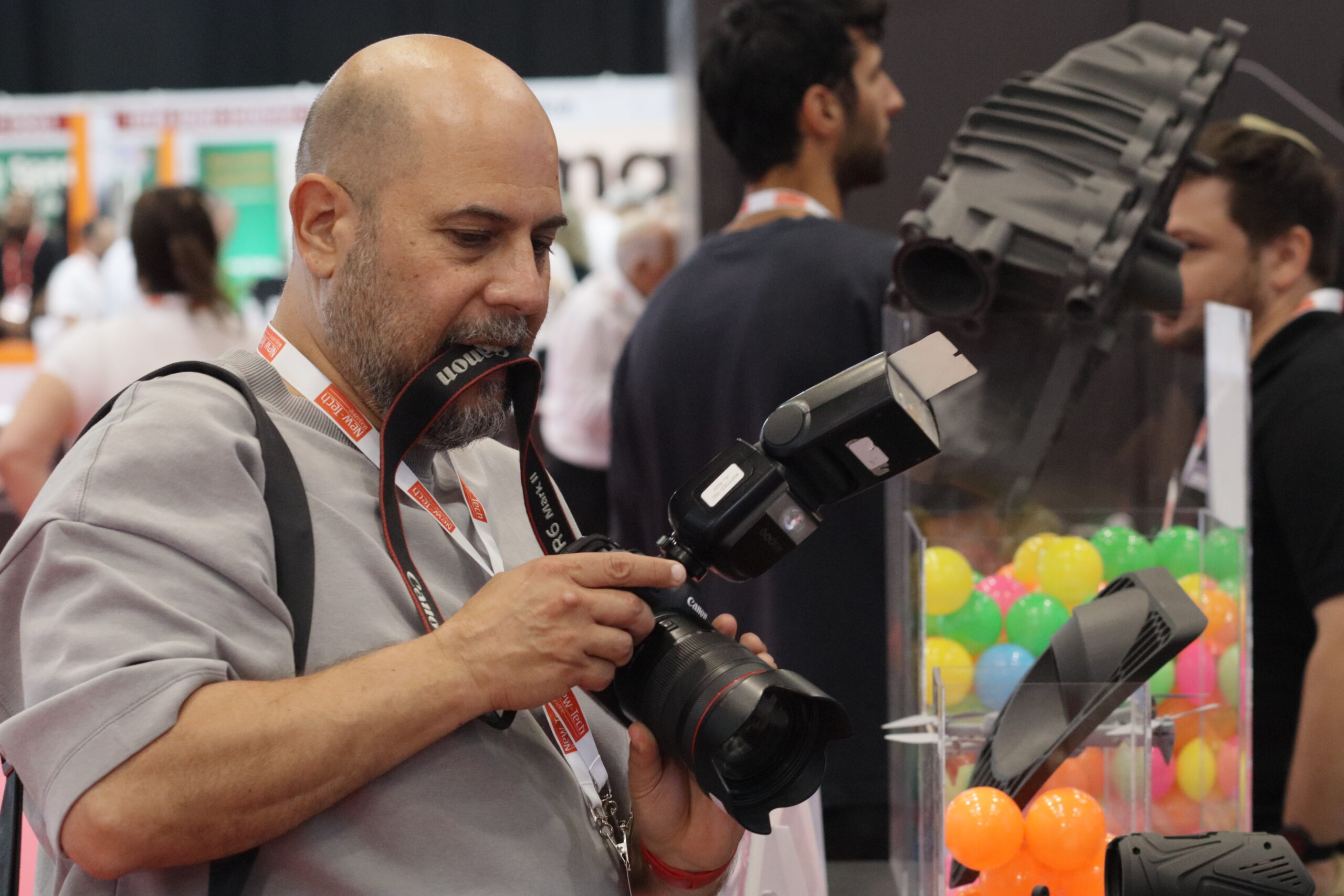
Look at the photographer below. Strap clamped in his teeth to keep it out of the frame, flash cocked for bounce, checking the screen before he moves on. That’s what a working day on an exhibition floor looks like.
One zoom does most of it
Carry a 24-70mm or 24-105mm and leave most of the bag at home. The wide end gets the whole stand, logo and all, from the aisle. The middle covers products on a table. The long end picks out a handshake or a demo from across the gangway without pushing into the conversation.
A full-frame f/2.8 zoom like the Sony FE 24-70mm F2.8 GM II or the cheaper Canon RF 28-70mm F2.8 IS STM is ideal. On APS-C, the Sigma 18-50mm F2.8 is small enough to carry for nine hours.
Add one fast prime, a 35mm or 50mm, for the evening reception, when the lights drop and the bar becomes the busiest stand in the hall.
Settings for halls
Shoot aperture priority or manual with auto ISO. Keep the shutter at 1/125 sec or faster for people, because conversations involve a lot of hand movement. f/4 is a good default: enough depth for two people in a conversation, and fast enough for indoor light at ISO 1600 to 3200.
Set white balance manually or shoot raw. Hall lighting changes from one stand to the next, and auto white balance will give you a different color for every booth. In raw you can fix it all in one pass later.
Turn on the silent electronic shutter for keynote stages, but watch for banding under LED walls. If you see stripes, go back to the mechanical shutter or change your shutter speed until they disappear.
A workflow that saves the day
Walk the hall once in the first hour before it fills up. Shoot every stand you’ve been asked to cover while it’s clean and empty. Those are the wide shots exhibitors use on their websites for years.
Then work the crowd. Stand at the corner of a booth, not in front of it, and wait for a demo or a conversation. Shoot in short bursts. Faces turned toward each other make the picture; people staring at phones don’t.
Product shots come last, in a quiet moment. Ask the exhibitor to clear coffee cups and leaflets from the table. Thirty seconds of tidying beats an hour of retouching.
Small things that matter
Wear the badge where it won’t swing into frame. Carry two batteries per body and charge at lunch. Keep the strap short, or do what the photographer above does and hold it out of the way. Back up cards before you leave the hall, not when you get home.
For lighting people and products under hall lights, see our guide to bounce flash at trade shows.