Event Video Audio: Why the Microphone Matters More Than the Camera, and Where 32-Bit Float Helps
Viewers forgive soft video. They don’t forgive bad sound. A slightly out-of-focus clip of a speech is still watchable. A sharp 6K clip where the speaker sounds like they’re at the bottom of a well gets switched off in ten seconds.
That’s why professional event crews spend as much effort on audio as on pictures, and why the camera with the best sensor isn’t always the right one for the job.
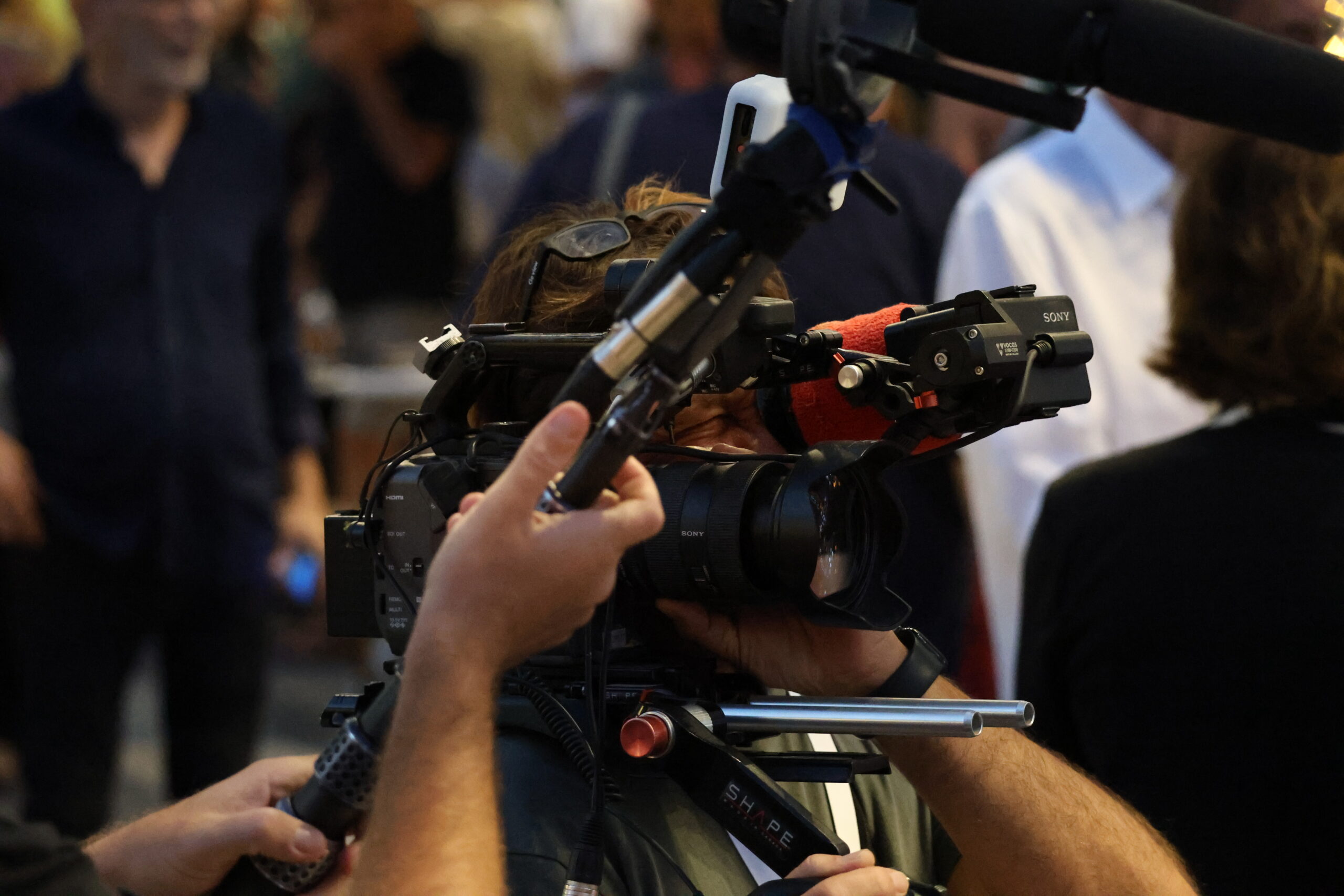
The photo below is a reminder of how much of a pro rig is about sound. A boom pole reaches in over the camera from the side, the operator’s own microphone sits on the camera body with its red windscreen, and the camera itself is almost hidden behind rods and cables.
Get the microphone close
The single most important rule in event audio is distance. Sound quality drops fast as a microphone moves away from the mouth, and the room’s echo and crowd noise rise to take its place.
A camera-mounted shotgun mic works for ambient sound and close interviews. For a speech from the back of a hall, it’s useless. You need a microphone near the speaker: a lavalier clipped to their collar, a wireless transmitter, or a feed from the venue’s sound desk. A boom operator, like the one in the photo, gets a mic within a meter of the subject while staying out of frame.
Small wireless systems have made this easy. A pair of clip-on transmitters with a receiver on the camera is now a standard part of any event kit, and several record a backup copy inside the transmitter in case the radio link drops.
Where 32-bit float audio changes things
Events have a nasty habit: the speaker talks quietly, then the room bursts into applause, or someone shouts, or the music kicks in. With normal 24-bit recording, you set your levels for the speech and the applause clips into distortion. Set them for the applause and the speech is buried in noise.
32-bit float recording stores so much range that you can’t clip it in practice. You record, then turn the levels up or down afterward without losing quality. For a solo shooter at an unpredictable event, that removes the single biggest audio risk.
More cameras now record it directly. The Nikon ZR records 32-bit float from its built-in mics or a hot shoe mic. The Panasonic GH7 and Lumix S1II do it with an XLR module, and Sony’s new FX5 does it through its XLR handle. Small field recorders and some wireless kits record it too, so any camera can benefit.
The feed from the sound desk
At conferences and concerts, the cleanest audio usually comes from the venue’s mixing desk. Ask the sound engineer for a feed before the event. You’ll need an XLR input on the camera, a handle module or a separate recorder, and a long cable or a wireless link.
Record the camera’s own mic as a second track at the same time. If the desk feed drops out, you’ll have something to fall back on.
Monitor everything
Wear headphones. Always. Watching the level meters isn’t enough; meters won’t tell you about a rustling lavalier, radio dropouts or a fridge humming in the corner. Closed-back headphones that block the room are worth their weight.
The camera matters, and our comparison of event video cameras covers which ones handle audio best. But if you have to choose between a better camera and a better microphone, buy the microphone.