Event Video Without a Camcorder: Sony FX30, FX5, Nikon ZR and Canon C50 vs the Sony PXW-Z200
Walk into any conference, product launch or church service with a video crew and you’ll still see shoulder camcorders. A big Sony with a long built-in zoom, an LED panel on top, a shotgun mic out front. They look old-fashioned next to a small cinema camera. They’re there for good reasons.
Look a little closer, though, and the second and third cameras in the room are usually mirrorless bodies. For a lot of event work, a compact cinema camera now does the job better and for less. Knowing which job suits which tool saves a lot of money.
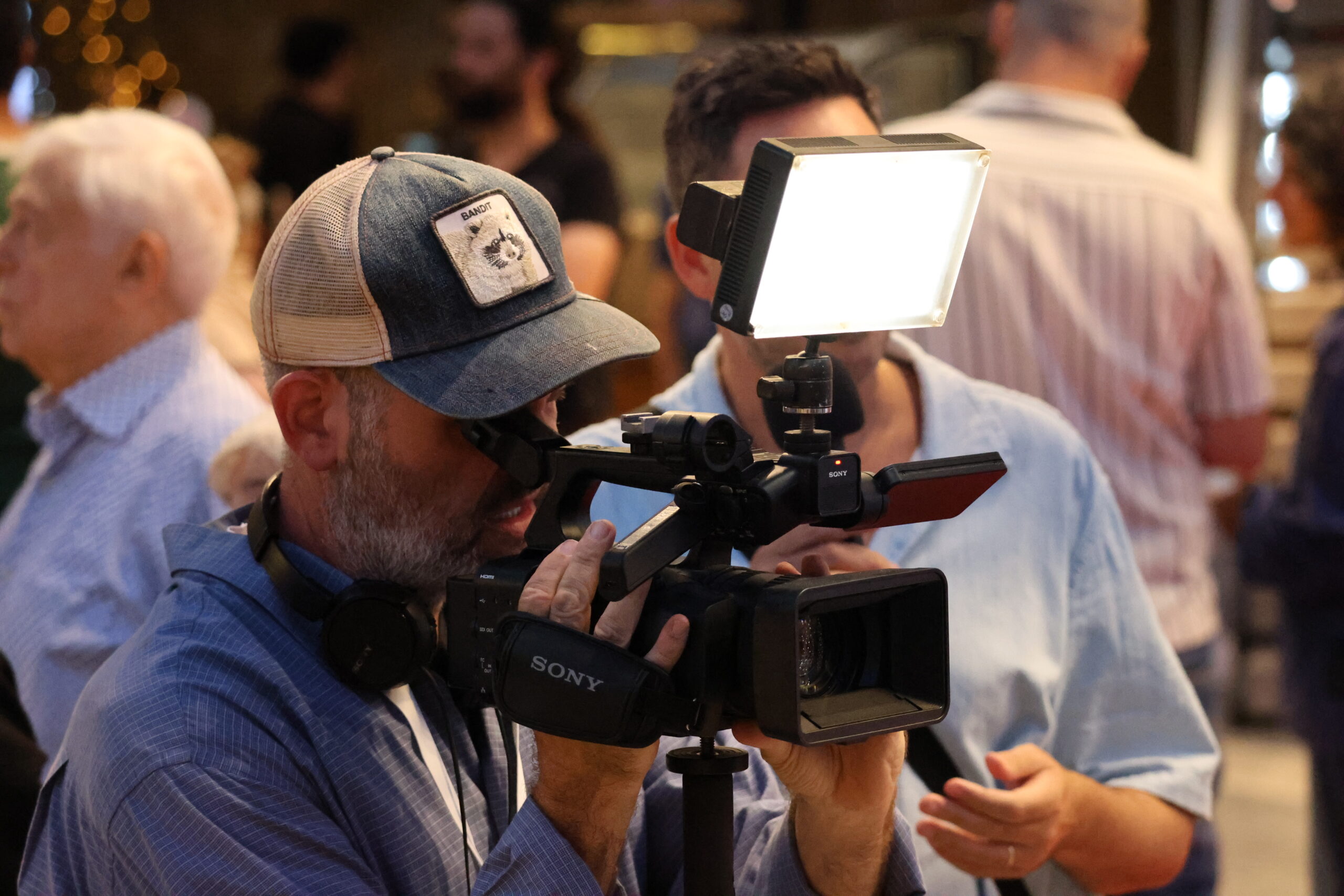
The photo below is the camcorder side of that split: a Sony professional camcorder with an LED panel, working a packed room.
What a camcorder still does better
Sony’s current handheld camcorder, the PXW-Z200, launched in 2024 at about $4,000. It has a 1-inch-type 14MP sensor, 4K up to 120p, a built-in zoom lens, XLR audio, a 12G-SDI output for live production and big BP-U batteries. It weighs about 2 kilograms.
That list explains the format. The zoom range is built in and moves smoothly under a rocker, so one operator can go from a wide room to a tight face without touching anything else. SDI feeds a live switcher with no adapters. The batteries last a long session. Everything sits on the shoulder, which is steadier for a two-hour keynote than any handheld rig.
If you shoot live-switched events, long ceremonies with one operator, or news, the camcorder is still the right tool.
What mirrorless cinema cameras do better
The sensors are much bigger. A full-frame or Super 35 sensor gives shallow depth of field and far cleaner images in dim rooms than a 1-inch chip. That’s the “cinematic” look clients now expect from event highlight films. They’re also much cheaper, and small enough to put on a gimbal.
The Sony FX30 is the entry point: $1,799, or $2,199 with an XLR handle, and about 646 grams with battery, card and handle fitted. Pair it with the Tamron 17-70mm F2.8 and you have a stabilized event zoom for a fraction of a camcorder’s price.
Sony’s new FX5, announced in July 2026, raises the bar. It records internal X-OCN raw from a stacked sensor, its XLR handle records four channels of 32-bit float audio, and its fan allows takes of up to 24 hours. It weighs 750 grams.
The Nikon ZR, at $2,199.95, records RED raw internally in a 630-gram body. It has no XLR input, but it records 32-bit float audio, which makes clipped audio from a sudden applause much less likely. A firmware update raised its clip length limit to 360 minutes.
Canon’s EOS C50, launched in late 2025 at $3,899, puts a 7K full-frame sensor, Dual Pixel autofocus and a two-XLR handle in a body of about 680 grams.
The Panasonic GH7 records without time limits and takes Panasonic’s XLR module for four-channel 32-bit float audio.
The weak spots
Mirrorless cameras still lack the camcorder’s built-in power zoom. Lenses with power zoom exist, like Sony’s FE PZ 16-35mm F4 G, but nothing matches a camcorder’s range. Battery life is shorter, SDI is often missing or needs a cage, and the ergonomics for shoulder work need a rig.
The usual crew setup
Most event crews now mix both. A camcorder covers the stage on a tripod or on the shoulder, feeding the switcher. One or two mirrorless cinema cameras with fast lenses shoot close-ups, audience reactions and B-roll for the highlight film.
A solo shooter on a budget should start with an FX30 and the Tamron 17-70mm, then add a second body. A crew building a live-production kit should keep the camcorder. For full-frame hybrid shooters who also need stills, the Sony A7 V and Lumix S5IIX cover both jobs.