Why You Should Hold a Camera in a Store Before Buying It Online
Most camera buyers now pick a body from reviews and spec tables, then order it online. It’s quick and usually cheaper. It also skips the one test no review can run for you: how the thing feels in your hands.
Two cameras with near-identical specs can feel completely different to use. One sits in your hand like it was made for you. The other has a grip your fingers don’t fit, a dial in the wrong place and a menu you’ll never learn. Ten minutes at a store counter tells you which is which.
That’s what the shopper below is doing. Standing at a glass cabinet full of bodies and lenses, looking closely before he asks to hold anything.
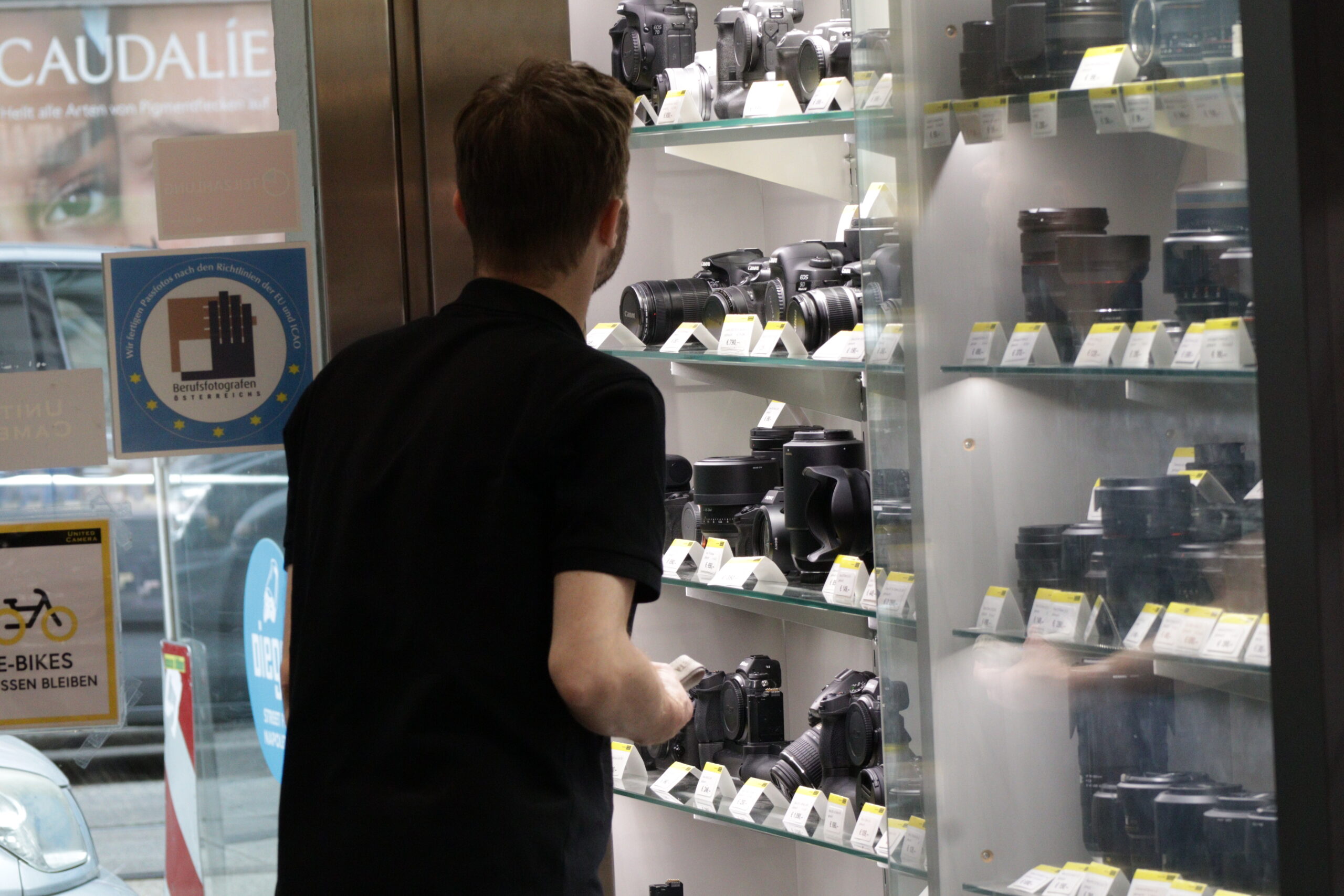
Photo: Media Gallery
What to check in ten minutes
The grip. Hold the camera the way you’d shoot, with the lens you’d actually use. Does your little finger hang off the bottom? Can you reach the rear dial with your thumb without shifting your hand? Small bodies like the Sony A7C II and Fujifilm X-M5 suit some hands and frustrate others.
The viewfinder. Put it to your eye, with glasses if you wear them. Can you see the whole frame and the info at the edges? Viewfinders vary a lot in size, brightness and how far your eye can sit from them, and spec numbers don’t convey that well.
The menus. Try to change three things you’d change often: ISO, autofocus mode and white balance. If you’re hunting through pages for each one, that’s how every shoot will feel until you learn it, or don’t.
The noise and the shutter. Fire a few frames. Some shutters are quiet and soft, some are loud. That matters at weddings, in churches and on stage.
The lens on the body. A camera that balances well with a small prime can feel front-heavy with a 24-70mm f/2.8. Try it with the lens you plan to buy.
Bring your own questions, and your own card
Store staff in specialist shops usually know the gear well, and most are happy to let you shoot a few frames. Bring a memory card and ask if you can take test shots home to look at on your own screen. Not every store allows it, but many do.
Ask about the things that annoy owners after a few weeks: battery life, overheating in video, how hot the grip gets. Staff who sell a lot of a model hear about its problems from returns.
Then buy wherever you like
Holding a camera in a store doesn’t oblige you to buy it there, though if the staff spent half an hour helping you, it’s fair to consider it. Many specialist stores match online prices or bundle extras, and buying locally makes returns and repairs easier.
If a store isn’t near you, the next best thing is renting the camera for a weekend, which we cover in our guide to renting versus buying gear.
The camera you’ll use most is the one you enjoy holding. Spec sheets can’t tell you which that is.