Photo and Video at the Same Event: Why Crews Split the Job Between Two Shooters
Every hybrid camera made in the last five years can shoot excellent stills and excellent video. So clients ask the obvious question: why pay two people? One shooter with one camera should be able to do both.
They can, for a small job. At a real event, they almost always can’t do both well. The two jobs want different settings, different light, different positions and a different kind of attention, all at the same time.
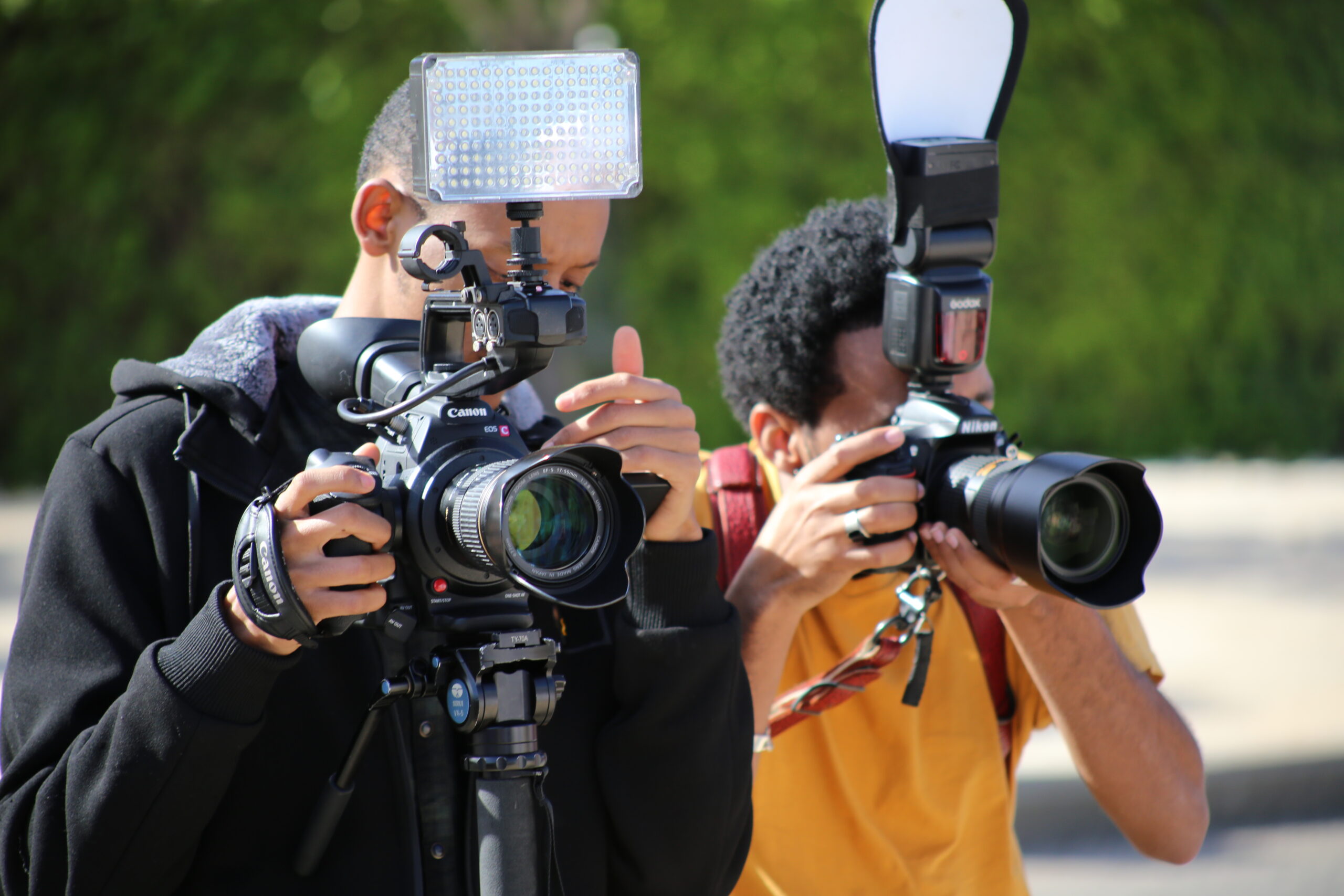
The photo below shows the split in one frame. On the left, a video shooter with a cinema camera on a support, an LED panel mounted on top. On the right, a stills photographer with a speedlight and a bounce card. Same subject, two completely different kits.
The settings fight each other
Video wants a fixed shutter speed, usually 1/50 sec for 25p or 1/60 for 30p, so motion looks natural. Stills of people moving want 1/125 sec or faster to freeze a gesture. You can’t have both at once.
Video wants continuous light. That’s why the cinema camera has an LED panel on it. Stills shooters prefer flash, which is brighter, freezes motion and runs off small batteries all day. But a flash firing in the middle of a video take ruins the clip with a white frame. The two lights can’t share a room comfortably either.
Video wants smooth, slow moves and long takes. Stills want you to jump to the decisive moment, shoot a burst and move on.
Positioning is different too
A video shooter covering a speech wants a stable spot, often on a tripod or monopod, with a clean audio feed. They stay there.
A photographer wants to move. Front row for the speaker, side aisle for the audience reaction, back of the room for the wide shot. Moving means walking in front of the video camera, which is the oldest argument at every event.
Good crews agree before the event starts: who owns the center aisle, where the video tripod goes, when the photographer can cross.
When one shooter can do both
Small jobs with one person on camera, a short interview or a product demo, are fine for one hybrid shooter. Set up for video, then grab stills from the video or switch the camera to photo mode between takes.
Cameras with fast sensors make frame grabs more practical than they used to be. Pulling a still from 4K or 6K video gives you an 8MP to 20MP image, plenty for social media and websites. The Nikon ZR and Lumix S1II both shoot high-resolution video that works this way.
If you hire one person anyway
Brief them clearly. Tell them which matters more, stills or video, and expect the other to be second best. A good hybrid shooter will tell you up front where the compromise lands.
And if you’re the shooter: set up two custom modes on the dial, one for stills and one for video. Switching between them should take one click, not a menu dive.
For the video side of event coverage, see our comparison of mirrorless cinema cameras and camcorders for event video.