Why Professional Photographers Use Flash in Broad Daylight
It seems slightly absurd to carry an electronic flash on a day when the sun is already providing more light than anyone could possibly want. Yet outdoor events are precisely where a good flash can earn its place in a photographer’s kit. The problem is rarely a shortage of light. It is where the light comes from, how hard it is and what it does to the faces of the people we are trying to photograph.
In this photograph, three people walk across a sunlit event plaza. Two wear conference badges; the man on the right, dressed in a white T-shirt and blue jeans, carries a camera with a substantial zoom lens, a lens hood and an external flash fitted with a small translucent diffuser. Reflections in the sunglasses of the woman in the middle, the almost brilliant white of the photographer’s shirt and the sharply defined shadows stretching across the paving stones give a good indication of the lighting conditions. There are people in the background standing under shade, just a few steps away from others in full sun. For an event photographer moving between these two environments, the exposure can change dramatically in seconds.
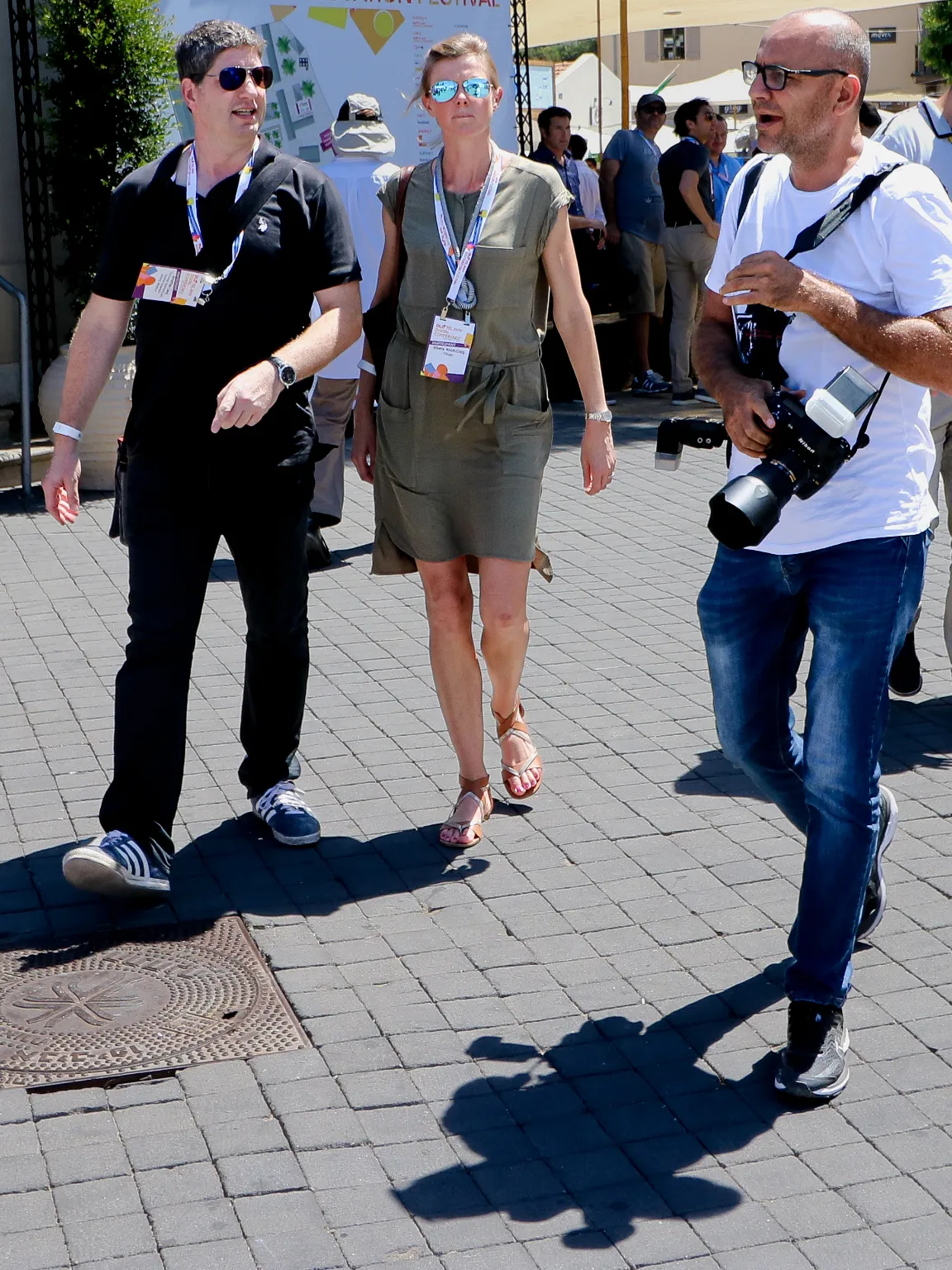
Photograph: PXEF.com.
The camera equipment visible here is a useful illustration of a daylight lighting technique, although the photograph itself cannot establish the photographer’s flash settings or whether he was firing the flash at that particular moment.
Look at what happens when sunlight comes from high above. Eyebrows cast shadows over the eyes, noses cast shadows across cheeks, and the area beneath the chin can become considerably darker than the rest of the face. A modern camera may record all of that information without difficulty, but recording a shadow and producing attractive light are two different things. Raising the shadows in editing can recover detail; it cannot change the original direction of the light, and excessive correction can leave a face looking flat or noisy.
Fill flash works by introducing a second light source that reaches the parts of a subject the sun does not illuminate sufficiently. It does not have to overpower the sun. In fact, for most reportage and conference photography, it shouldn’t. The sun remains the principal light source, while a modest burst from the camera gently reduces the contrast between bright and dark areas. The result, when the balance is right, looks less like a photograph taken with flash and more like a photograph taken in unusually cooperative sunlight.
A sensible starting point is to set the exposure for the existing light, preserving important highlights, and then introduce flash at a reduced output. With a compatible TTL flash, try flash exposure compensation of around -1 EV, adjusting toward -2 EV for a subtler effect or toward zero if the face still needs more light. These are starting points, not universal settings. Subject distance, clothing, the angle of the sun and the camera’s metering system all affect the result. Take a frame without flash and another with it. Comparing them is a surprisingly effective way of learning how little additional light is sometimes needed.
Working Within Flash Synchronization Limits
There is a technical complication in bright sunlight: flash synchronization. A conventional focal-plane shutter can normally synchronize an ordinary flash pulse only up to a certain shutter speed, commonly somewhere around 1/160 to 1/250 second, depending on the camera. In full sun at ISO 100, an exposure around 1/200 second at f/11 is a reasonable starting estimate. Open the aperture to f/2.8, however, and the equivalent shutter speed approaches 1/3200 second. That is considerably faster than ordinary flash synchronization allows.
High-speed sync, or HSS, solves this problem on compatible camera and flash combinations by emitting a rapid sequence of light pulses as the shutter travels across the sensor. It allows the photographer to use a wide aperture outdoors for subject separation while retaining some fill light. The price is reduced effective flash range and greater demand on the battery, particularly at very fast shutter speeds. A small flash that comfortably illuminates a nearby face at normal synchronization speed may struggle with a person several metres away in HSS. An ND filter is another option when a wide aperture and normal flash synchronization are desirable, although it also attenuates flash light entering the lens. Check the camera’s shutter mode as well: some electronic shutter modes disable flash or impose different synchronization limits.
Getting Useful Light From a Small Flash
The little diffuser visible on the photographer’s flash deserves a word of its own. Outdoors, a small translucent cap does not magically turn a speedlight into a large, soft light source. Its apparent size relative to a subject several metres away remains tiny, and there is usually no nearby ceiling or wall to return the scattered light. It may be convenient to leave the accessory attached when moving between indoor and outdoor spaces, but a bare, forward-facing flash is often more efficient for daylight fill. A larger modifier placed close to the subject can produce genuinely softer light, though that is a rather different proposition when walking through a crowded conference.
Distance matters more than many photographers expect. Double the distance between a flash and the subject and, under the usual point-source approximation, only about a quarter of the illumination reaches the subject. A speedlight that works beautifully for a conversation at arm’s length may contribute very little to a group photographed from across a plaza. For larger groups, more distant portraits or deliberate attempts to compete with direct midday sun, a more powerful battery strobe may be justified. Our guide to speedlights versus battery strobes examines the practical differences between the two.
One of the nicest uses of fill flash is with the sun behind the subject. Backlighting can produce beautiful separation around hair and shoulders, but the face may be considerably darker than the background. Exposing for the face alone can wash out the sky, while exposing for the sky alone can leave the person in silhouette. A controlled amount of flash gives the photographer a third option: retain the atmosphere of the background and bring the face into the desired tonal balance. Off-camera flash offers more freedom over the direction of that light, but an on-camera unit is often the practical choice when people are moving and there is no time to set up a stand.
There are also times when the flash is best left switched off. Open shade can provide excellent natural light; directional sunlight can give a street photograph its character; and a flash fired indiscriminately at every passing conference guest can be distracting. At close distances, particularly with reflective glasses or pale clothing, too much frontal flash may produce glare and unnaturally bright highlights. For an extended event, spare batteries and attention to recycle time and thermal limits are more useful than firing repeated full-power bursts.
The photographer in the white shirt is carrying equipment that gives him a choice. That, rather than the sheer quantity of hardware, is the point. The ability to introduce a little light exactly when it is needed can make the difference between a technically acceptable picture and one in which the people actually look good. The sun provides plenty of light for free. Unfortunately, it does not take requests.