Speedlight vs Battery Strobe: Which On-Location Flash to Buy for Portraits, Events and Sunlight
Sooner or later most photographers want more light than the sun or the room is giving them. The question is what to buy: a hot-shoe speedlight, a compact battery strobe, or a bigger battery monolight. A store’s flash wall shows all three side by side, and they look more alike than they are.
The difference comes down to power, recycle time and what you need to stick on the front.
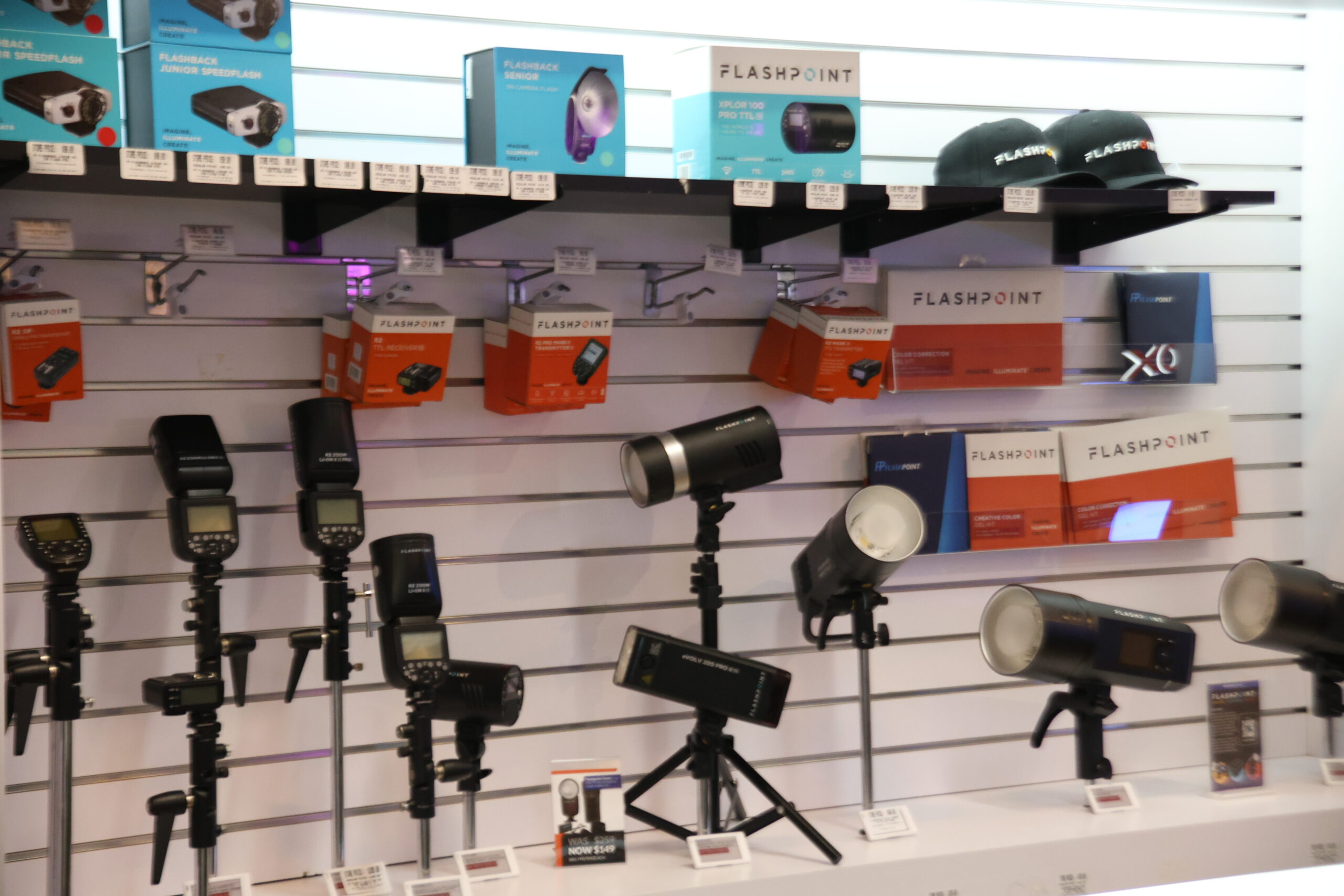
Photo: Media Gallery
Speedlights: small, cheap, enough for most indoor work
A speedlight sits on the camera’s hot shoe or on a light stand with a trigger. It runs on AA batteries or a small lithium-ion pack, it tilts and swivels for bouncing, and it’s light enough to carry several.
Indoors, a speedlight is usually all you need. Bounced off a wall or ceiling, it lights a person or a small group beautifully, as our guide to bounce flash at trade shows shows. Two or three speedlights on stands can light a small portrait setup.
The limit is power. Through a big softbox, or outdoors against bright sun, a speedlight runs out of output quickly and needs a long time to recycle between full-power shots.
Battery strobes: the step up
Compact battery strobes, the round-headed lights in the photo, sit between a speedlight and a studio light. They’re typically several times more powerful than a speedlight, with a lithium-ion battery good for hundreds of full-power flashes and much faster recycling.
That extra power matters outdoors. To light a portrait while darkening a bright sky, you need a lot of flash, especially through a modifier. A battery strobe makes that possible without a generator.
Bigger battery monolights go further again. They take studio modifiers directly, often with a Bowens-style mount, and can overpower midday sun. They’re also heavy, and you’ll want an assistant or a sandbag.
Systems and triggers
Pick one flash system and stay with it. Godox, and brands that sell Godox lights under their own names such as Flashpoint, have become the default for many photographers because one wireless trigger controls speedlights and strobes alike, with versions for Canon, Nikon, Sony, Fujifilm and other cameras. Camera makers’ own flashes integrate well but cost more and rarely mix across brands.
Make sure the system supports TTL for your camera (automatic flash exposure) and high-speed sync, which lets you use shutter speeds faster than the camera’s normal flash limit. High-speed sync costs power, which is another reason to want a strobe outdoors.
What to buy first
One good speedlight and a wireless trigger. Learn to bounce it, then take it off the camera onto a stand. That covers events, interiors and most portraits.
Add a battery strobe when you start shooting portraits outside, using big modifiers, or fighting the sun. That’s the moment a speedlight stops being enough.