Sports Photography Gear Guide, Cameras and Lenses for Race Day
There is a lot going on in this photograph before anyone even raises a camera. A sports photographer in a fluorescent green shirt and white visor stands beside a road-race course, pointing toward a young spectator while another man gestures from the edge of the frame. A big white telephoto lens rests in his left hand. More camera gear hangs from his chest and hip, and a substantial black backpack covers most of his back. Temporary barriers, bright late-afternoon sunlight and people moving in the background make the scene unmistakably busy.
The interesting part is how little of this equipment is packed away. At a race, the runner coming around the next bend will not wait while a photographer changes lenses. The photographer needs long reach for the course, a wider view for spectators and finish-line reactions, and enough freedom to move without swinging a heavy lens into the crowd. The photograph is a good illustration of the real assignment: manage the kit and the people around you, then catch the moment.
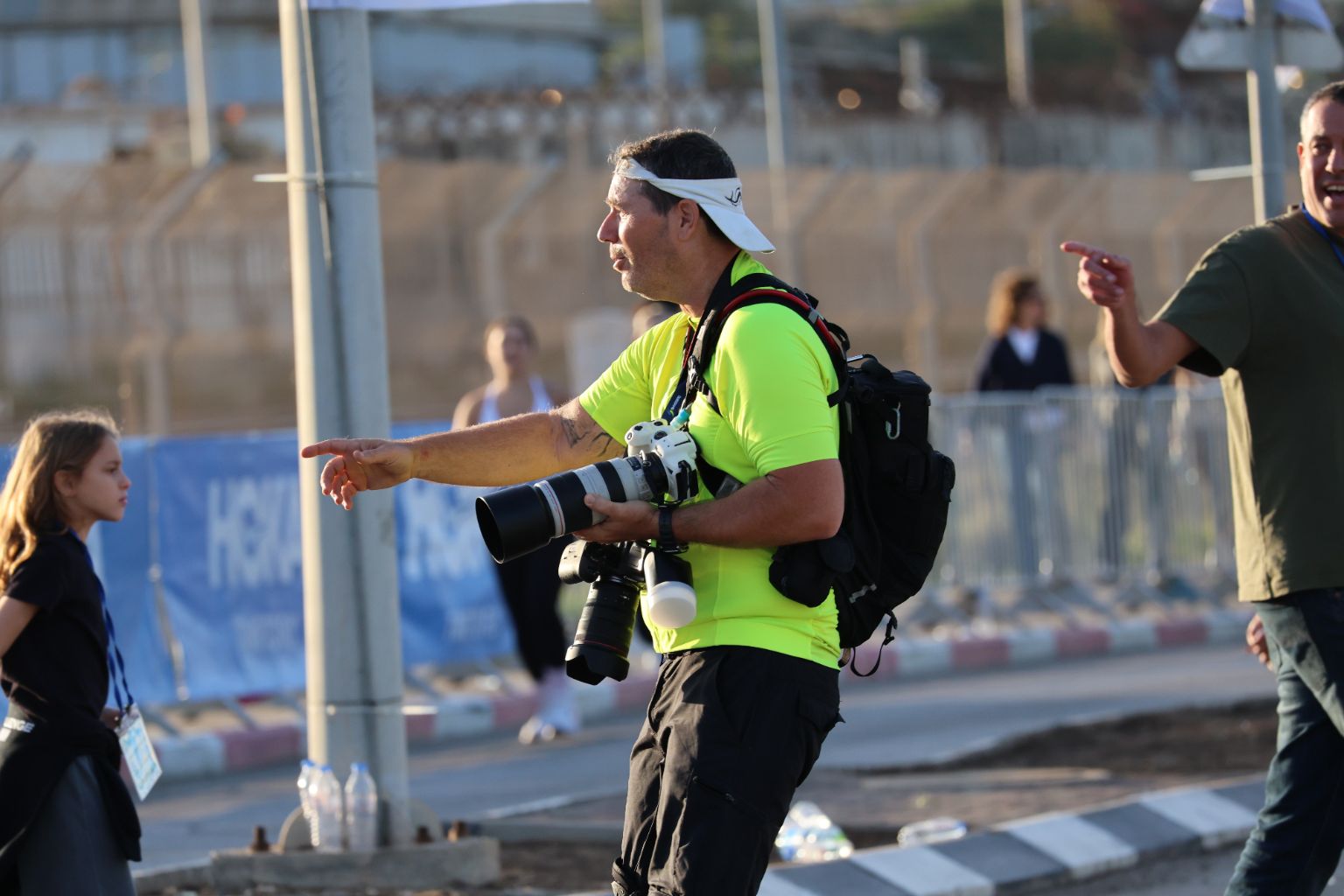
Photo: Pixel Effects
For outdoor sports, a responsive mirrorless camera with reliable continuous autofocus and tracking is a better starting point than chasing the highest megapixel count. An APS-C body gives a narrower field of view with the same lens, useful when access to the action is limited. A Canon EOS R7 is one practical example, while a full-frame body can make more sense under stadium lights or indoors. Our EOS R7 review looks at the trade-offs for sports and wildlife shooting. A second body is valuable because it keeps another focal length ready and provides a backup when a camera fails. There is a fuller discussion in why photographers carry two camera kits.
The lens earns its place according to where the photographer can stand. A 70-200mm F2.8 is hard to beat for nearby action, trackside portraits and indoor sports, where its wider aperture helps hold a fast shutter speed. A 100-400mm zoom gives much more reach across a road, field or stadium in daylight, although slower versions become difficult under poor lighting. For a light outdoor Canon RF setup, the RF 100-400mm F5.6-8 IS USM is worth considering; see our field assessment of the RF 100-400mm. A 24-70mm or 24-105mm on the other body gets the start line, the volunteers, the families and the small gestures that give the event its human story.
Then there is the carrying system, the most overlooked part of a sports kit. The photographer pictured here has cameras hanging at different heights, a large backpack and what appears to be a harness across his chest. That can save time, but only when the straps are adjusted so lenses do not knock into each other or the people nearby. Anchor a heavy telephoto by its tripod collar when the manufacturer provides suitable attachment points, check every quick-release buckle, and keep a second safety connection on expensive gear. A monopod is useful beside a football pitch with a large lens, but at a crowded road race it can become another thing to trip over. Carry only what you can control.
The settings should be ready before the runners arrive. Continuous AF with subject tracking, a shutter around 1/1000 second as a starting point for running action, and Auto ISO make a useful baseline; faster movement can call for 1/2000 second or more. Leave some room in the frame around unpredictable subjects. For a sense of motion, pan with a slower shutter instead of freezing every stride. Shoot RAW when changing light makes exposure and white balance difficult. Electronic shutters can be fast and quiet, but check for distortion from rolling shutter and banding under artificial lights before trusting them for an entire assignment.
Spare batteries, several tested memory cards, a lens cloth, weather protection and water belong in the kit. So does a plan for where to stand without obstructing participants, medical staff or marshals. Race coverage is partly about anticipation and partly about courtesy. The exchange in the photograph, with the photographer gesturing toward a spectator instead of staring through his viewfinder, is a reminder that communication matters as much as autofocus.
The best sports photography kit is the one that lets you react quickly and keep working for hours. A camera body you know, two complementary focal lengths and a carrying arrangement that stays out of your way will do more for your pictures than an overflowing bag of rarely used lenses. The goal is to photograph the race, after all, not spend the day wrestling with the equipment.
As an Amazon Associate I earn from qualifying purchases.