The Camera Is Only the Beginning: A Working Video Rig in the Wild
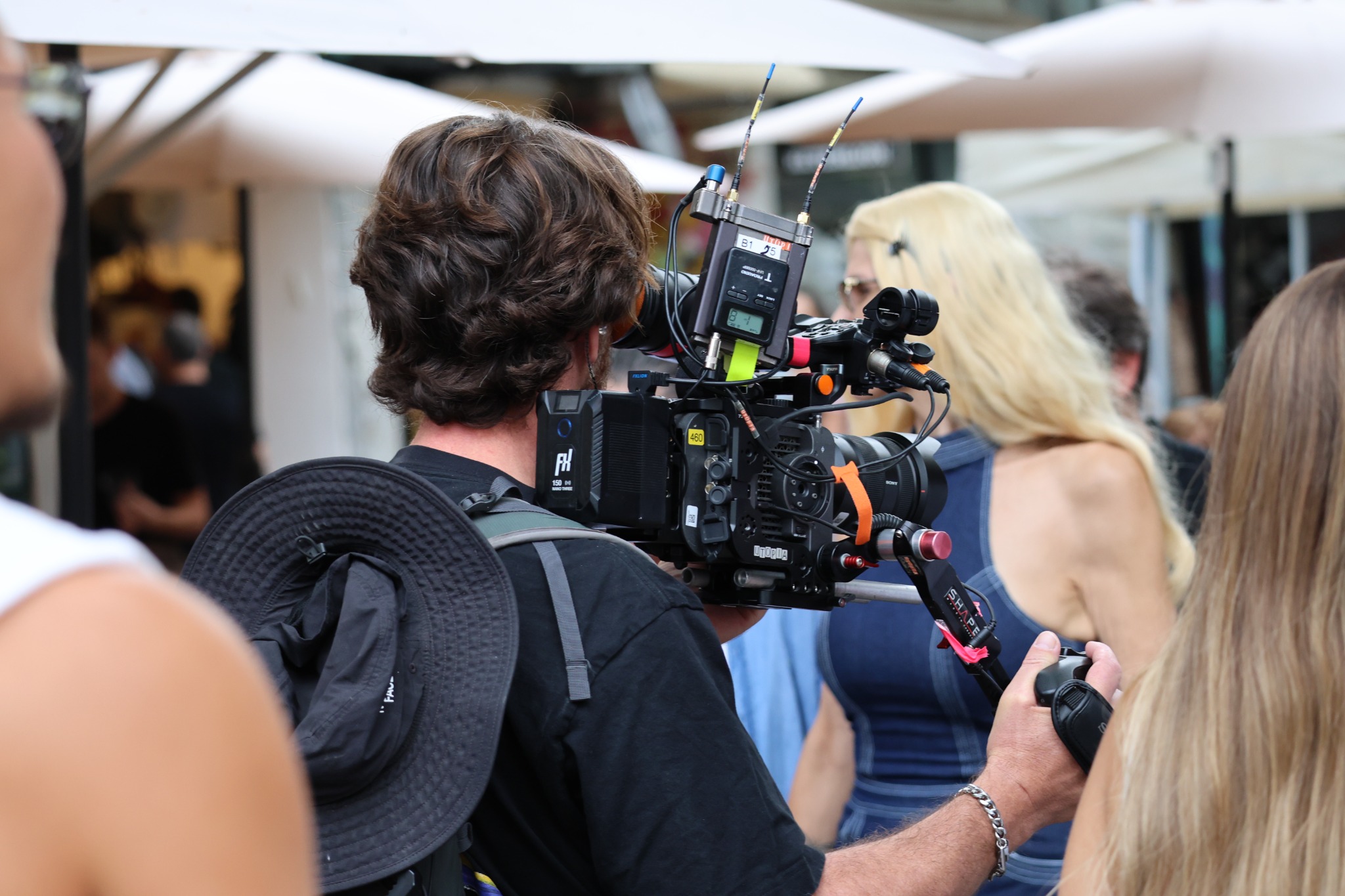
Camera reviews usually give us a beautifully isolated object against a clean background. This photograph gives us something more interesting: a camera earning its keep. An operator stands in a crowded outdoor setting beneath overlapping white umbrellas, with people pressing into the edges of the frame and a blonde woman just beyond the lens. The camera itself is surrounded by the things that make it usable for sustained filming. Two slender antennas rise above the operator’s head, cables loop around the body, a substantial battery sits toward the rear, and a forward handgrip reaches down toward his right hand. Bright orange, pink and fluorescent yellow-green markings interrupt the black hardware. A wide-brimmed black hat hangs against his backpack. There is nothing showroom-like about the arrangement, which is precisely why I like it.
Look closely and the photograph becomes a small lesson in how video equipment accumulates around a job. The Sony-branded lens is pointed into the crowd, while the camera body sits inside a larger assembly of support hardware, connections and controls. An audio unit with a small display occupies an elevated position, with the antennas extending into the relatively clear space above. The rear battery is almost as visually prominent as the camera. We cannot establish the exact camera model or every component’s function from this angle, and there is no need to pretend otherwise. The visible arrangement already tells a useful story: recording moving images involves power, sound, handling and access, all competing for space around the same pair of hands.
Photograph: MediaGallery.org.
The handgrip is the detail my eye keeps returning to. It sits well below and ahead of the camera body, allowing the operator to hold the assembly without reaching awkwardly around its side. His right arm extends toward it while the rig rests at shoulder level. That changes the relationship between person and equipment. A bare camera asks the operator to adapt to the position of its built-in grip; a developed rig lets the operator move the grip to a more useful position. Of course, adding hardware also adds weight and more things to tighten. Anyone who has discovered a loose clamp halfway through a shoot will appreciate that little bargain.
The battery deserves similar attention. In buying discussions, power often arrives near the end, somewhere after resolution, frame rates and autofocus. On location, it can move straight to the top. An external battery can support longer working periods, depending on the equipment and its power demands, but its physical position also matters. Weight behind the camera can help offset weight toward the front, although the final balance depends on the whole assembly. This photograph does not tell us whether the operator has achieved perfect balance. It does show why judging a video camera’s comfort from its body weight alone leaves out a large part of the experience.
Then there are the cables. Several are clearly visible, crossing between the upper accessories and the camera, curving around the lens area and passing close to the operator’s working space. They look untidy compared with a product photograph, but a working rig has to accommodate real connectors in real places. The practical question is whether each cable has enough freedom for the movements it needs, without hanging where it can snag or pull against a socket. I would happily spend less time admiring a rig’s silhouette and more time checking what happens to its cables when the operator lowers it, turns through a doorway or puts it down.
The surrounding crowd gives all this hardware its context. A blurred shoulder fills the left foreground, long hair frames the right edge, and the woman ahead is partly hidden by the equipment. There is barely any empty space. In that environment, a rig’s dimensions become consequential: the projecting grip, raised antennas and rear battery all travel with the operator whenever he changes position. Compactness is useful, certainly, but so is having the controls where fingers can find them without a visual search. The photograph catches that tension beautifully. Everything needs to fit around a person who is already trying to fit between other people.
For PhotoVideoGear readers, this is the sort of image that makes equipment discussion feel grounded again. A camera body may be the most expensive purchase, but the finished working tool includes everything needed to keep it powered, supported and connected while the scene unfolds. My own bias is toward adding an accessory only when it solves a problem I can name. Looking at this setup, I find myself asking what each piece makes easier, how quickly it can be adjusted and whether it will still feel sensible after an hour on the shoulder. Those are less glamorous questions than a specification comparison. They are also the questions that follow you home after a long shoot.