Canon EOS 5D Mark III: The Camera Behind the Hands
The first thing I notice in this photograph is where the photographer has put his hands. His left hand cups the lens, with a finger resting against its ribbed barrel, while his right holds the padded pan handle beneath the camera. Between them sits a Canon EOS 5D Mark III, mounted on a video head and pointed toward something outside our view. It is a modest arrangement compared with the elaborate rigs that tend to dominate equipment discussions. A camera, a lens, support and someone paying attention. I find that rather reassuring.
The scene is bright and ordinary in the best possible way. The operator wears black-framed glasses and a navy polo shirt, its blue fabric catching the sunlight along his shoulder. His face appears in profile, with a slight smile and his attention directed toward the camera. Behind him, pale railings, a vertical pole and a red circular traffic sign dissolve into soft shapes, with dark green foliage filling the upper right corner. The camera occupies the left side of the photograph, balancing the much larger shape of the man on the right. A red-edged strap hangs below the mounting platform. Nothing about the picture looks arranged to sell equipment, yet it makes me want to pick up a camera.
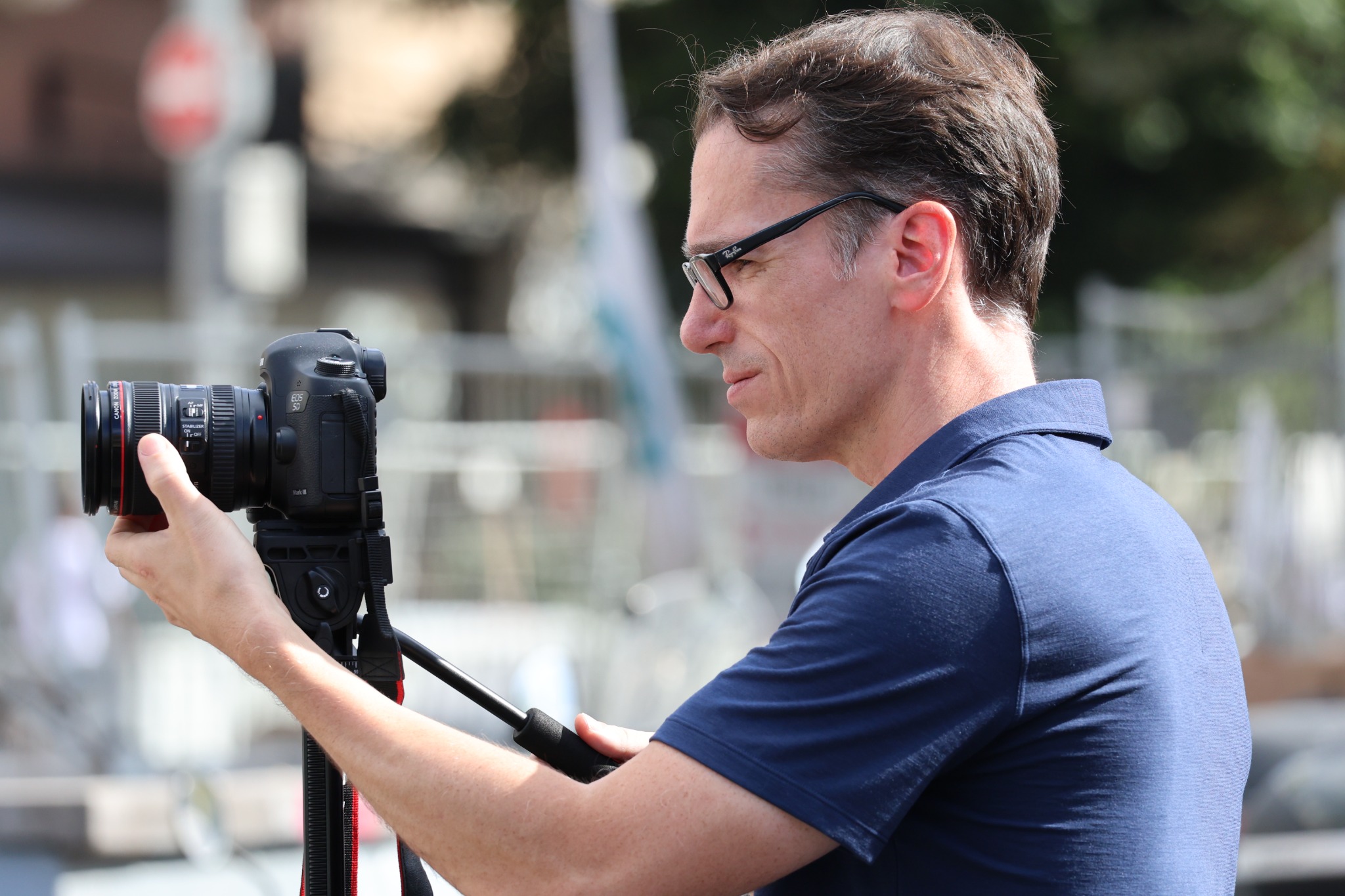
Photograph: MediaGallery.org.
The body’s EOS 5D badge and Mark III lettering are visible, as are the red ring and Canon branding on the lens. The lens’s exact focal range is less clear, so I would leave its identity there. More revealing than a model number is the way the equipment fits together. The lens barrel remains accessible, the camera sits above the head’s tilt mechanism, and the long handle places a control point comfortably away from the body. The operator can reach the lens while keeping his other hand on the support. That physical arrangement is a large part of what makes a setup usable, although it rarely gets the attention given to the camera’s specifications.
A pan handle looks almost comically simple beside a camera full of electronics. It is a lever with a grip. Yet the distance it puts between the operator’s hand and the head’s rotation axis can make small movements easier to control. The head and its adjustment still matter, as does the balance of the camera above it. You cannot bolt a handle onto an awkward setup and expect graceful movement to appear by magic. Still, this photograph is a useful reminder that improving the way a camera moves may involve something you can see and feel immediately, rather than another option buried in a menu.
I also like the left hand’s position because it leaves the operator involved with the lens. We cannot tell whether he is adjusting zoom, checking focus or simply steadying the assembly at the instant the photograph was taken. A still image cannot answer that. What it does show is room to work. The lens is not buried behind accessories, and his fingers do not have to negotiate a cage or a bundle of cables to reach it. There are jobs that need those additions, of course. There is also pleasure in an arrangement where the next control you need is already under your hand.
Seeing a 5D Mark III in this setting brings up the familiar question of when older equipment stops being useful. My answer starts with the intended result. Can the camera produce the files the job needs? Can the operator focus, frame and record with enough confidence? Does using it introduce a limitation that will actually matter? Those questions can lead to an upgrade, and sometimes quite quickly. They can also lead to a less expensive conclusion: the camera is adequate, while the support, sound, lighting or preparation needs attention. That conclusion is less exciting to shop for. Funny how often it is the useful one.
There is a trap here, too, in becoming sentimental about familiar cameras. A comfortable grip does not make missing capabilities appear, and affection for an older body will not rescue footage that fails a delivery requirement. But neither does a newer body automatically improve the operator’s timing or make a clumsy camera movement watchable. The photograph holds my interest because the person and the equipment seem to occupy the same task. His hands have somewhere sensible to go. The camera has support. His attention is free to move toward whatever is happening beyond the frame.
That is the part of gear ownership I value most: reaching the point where operating the equipment feels settled enough that the subject gets your attention back. This Canon, its red-ring lens and the plain black pan handle make a persuasive little picture of that possibility. No dramatic accessory tower, no table covered in spare parts. Just a working arrangement, out in the daylight, with someone ready to use it.