Canon RF 135mm F1.8 for Street Photography, Finding Stories at a Distance
The Canon RF 135mm F1.8 L IS USM is not the obvious choice for street photography. The tradition favors 28mm, 35mm and 50mm lenses, which put photographers close to their subjects and preserve the surrounding environment. A 135mm telephoto instead invites a different way of looking: watching from farther away, selecting a gesture or face, and isolating small stories within the city.
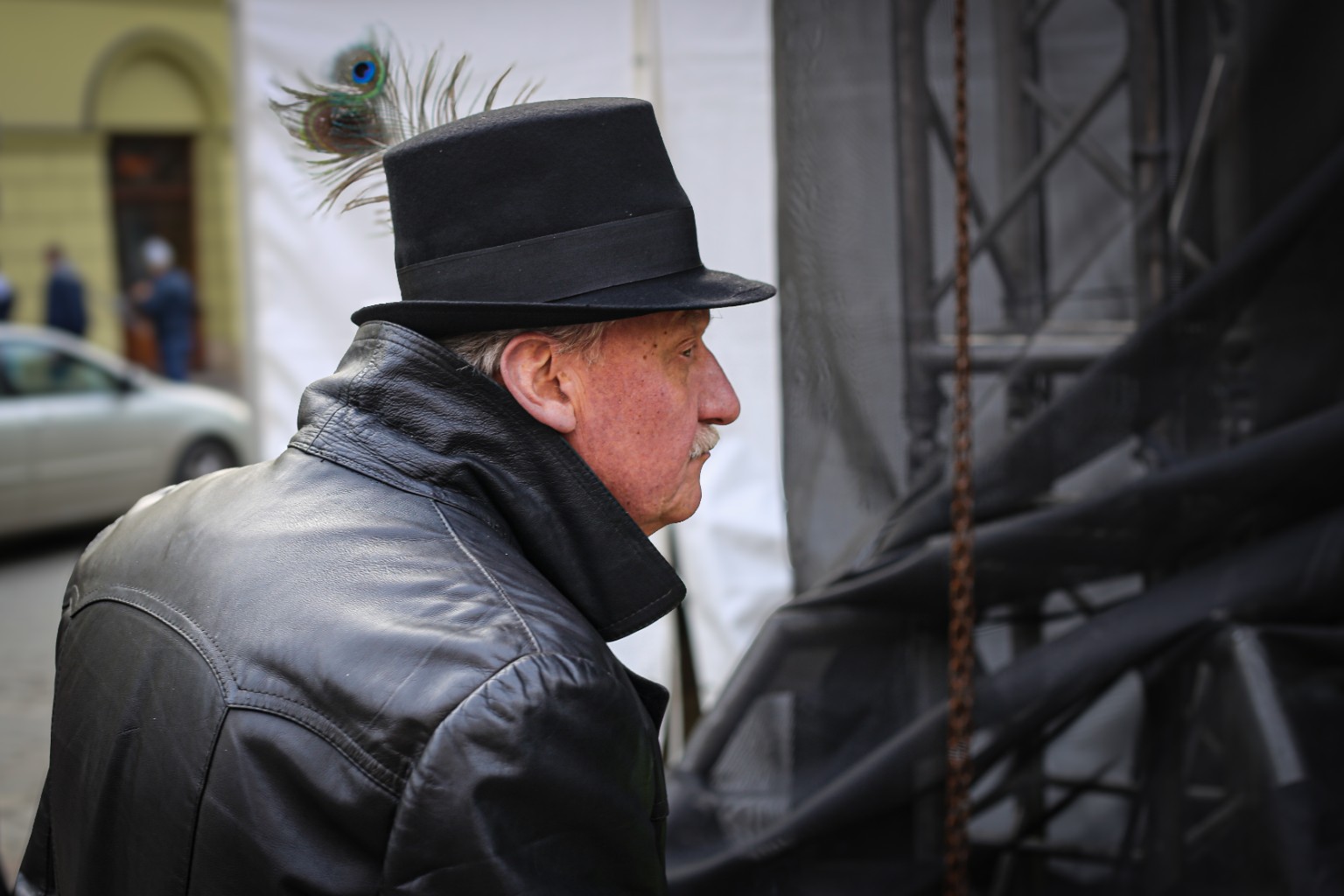
Street portrait of a man wearing a black felt hat decorated with a peacock feather. Image hosted by MediaGallery.org. The original capture lens is not verified; the photograph illustrates the compositional approach rather than serving as an RF 135mm optical test.
The photograph above shows why a longer focal-length perspective can be compelling. The man’s leather jacket fills the foreground, while his profile and unusual peacock feather attract attention. A pale wall, blurred pedestrians and a passing car establish a street setting, and the dark diagonal metalwork on the right gives the image structure. The feather is a tiny accent of color against mostly black clothing. It makes an ordinary passing encounter memorable.
The RF 135mm F1.8 offers an unusually bright aperture for this focal length. At F1.8, a nearby subject can stand apart from a distant, busy background. But maximum blur is not always the goal: F2.8 or F4 can keep the eyes, nose, hat and other important details in focus while still separating the person from the surroundings. When the environment matters to the story, F5.6 may be the better choice.
Its Dual Nano USM autofocus and compatibility with subject detection on suitable EOS R cameras are useful when people move unpredictably. Optical image stabilization is rated up to 5.5 stops on its own, with greater coordinated correction possible on compatible stabilized bodies. That helps with camera shake, not subject motion. A shutter speed around 1/500 second or faster is often a sensible starting point for walking people; quieter subjects permit slower speeds.
There are practical drawbacks. At roughly 935 grams, the RF 135mm F1.8 is not discreet. It is expensive, relatively conspicuous, and much less forgiving of a subject who suddenly walks close to the camera. The narrow field of view makes it difficult to capture rapidly unfolding scenes at arm’s length. Working with it demands patience, distance, anticipation and a willingness to miss some moments.
For an EOS R photographer, aperture priority with Auto ISO and a sufficiently fast minimum shutter speed is a useful starting point. Servo autofocus with people detection works for moving portraits, while a carefully positioned focus point can be more dependable when foreground railings or signs obstruct the subject. Watch the edges of the frame as carefully as the face: at 135mm, a stray post or bright patch of background can change the balance of the entire composition.
This is not a replacement for a compact 35mm street lens. It is a complementary perspective, particularly attractive to photographers who notice individual characters, gestures, unusual clothing and layers of urban geometry. The reward is not simply background blur. It is the ability to find a person within a crowded scene and give that person’s small story room to breathe.
The peacock feather in the sample image illustrates the point. Without it, the frame is a characterful street portrait. With it, there is a second story: a deliberately distinctive personal style against an otherwise ordinary urban backdrop. A telephoto approach can help a photographer notice and emphasize precisely that kind of detail.
Find the Canon RF 135mm F1.8 L IS USM on Amazon
As an Amazon Associate I earn from qualifying purchases.