Canon EOS R100 Lens Kit: Five Cheap Lenses That Make Canon's Entry Camera a Complete System
The Canon EOS R100 costs less than most lenses. That’s its strength and its trap. People buy it with the kit zoom, and the kit zoom is where most of them stop. But the RF mount has a set of cheap, small lenses that turn this little camera into something much more capable, often for less than the price of the body.
Here’s a real kit, built around an R100 over a couple of years. Every lens in it cost a few hundred dollars or less.
The photo shows it laid out: the R100 with the RF 16mm f/2.8, the RF 24-105mm f/4-7.1 kit zoom, the RF-S 10-18mm ultra-wide, an older EF 75-300mm telephoto on Canon’s EF-EOS R adapter, and a TTArtisan manual-focus prime.
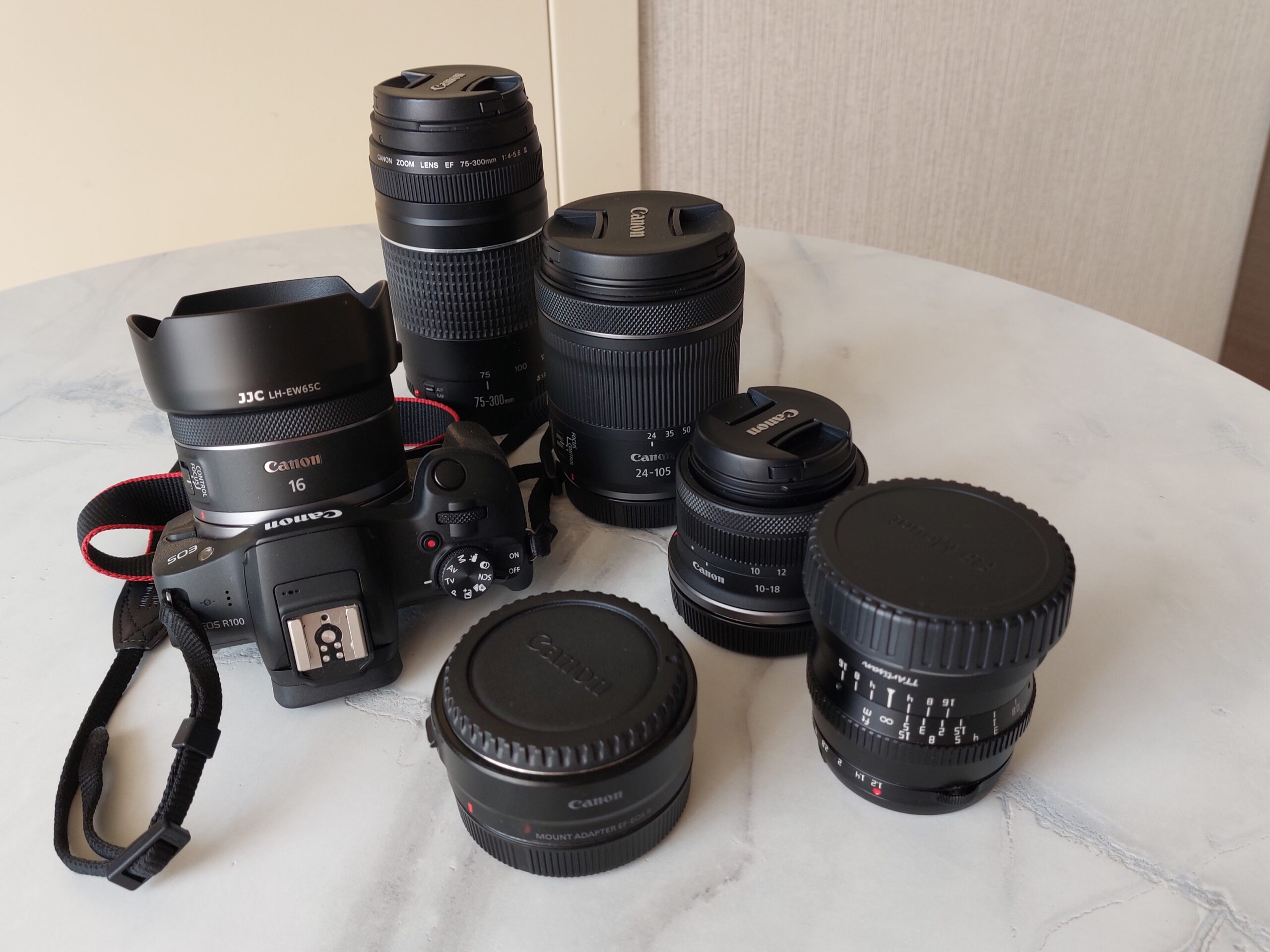
Remember the crop. Canon APS-C multiplies every focal length by 1.6, so the numbers below include the full-frame equivalent.
The everyday zoom: RF 24-105mm F4-7.1 IS STM
Canon sells this as a full-frame kit lens for $399.99, and it works on the R100 as a 38-168mm equivalent. That’s a long, useful range for travel and family photos, longer than the RF-S 18-45mm that comes in the R100 box. It has 5 stops of optical stabilization, which matters a lot on the R100 because the camera has none of its own. It weighs 395 grams.
The trade is the wide end. At 38mm equivalent, it can’t get a room or a street in frame. That’s what the next two lenses fix.
The wide angles: RF-S 10-18mm and RF 16mm F2.8
The RF-S 10-18mm F4.5-6.3 IS STM is the best-value lens in the kit. It weighs 150 grams, costs about $330 and gives a 16-29mm equivalent view with stabilization. Interiors, landscapes, architecture, holding the camera at arm’s length for a group selfie. If you buy one lens after the kit zoom, make it this one.
The RF 16mm F2.8 STM ($299.99, 165 grams) is a full-frame lens that becomes a 26mm equivalent on the R100. That’s a wide-normal view for street and travel, and f/2.8 gathers about two stops more light than the kit zoom in a dim restaurant. It has no stabilization, so keep shutter speeds sensible. The JJC hood in the photo is a cheap third-party copy of Canon’s, and it works fine.
The telephoto, and why to skip the cheap one
The EF 75-300mm in the photo is an old Canon EF design that many people already own. On Canon’s EF-EOS R adapter (the basic version is $99) it mounts with full autofocus and becomes a 120-480mm equivalent. Canon even sells the same optics as the RF 75-300mm F4-5.6, at about $219.
Don’t buy it new. It has no stabilization, a slow motor and soft results at 300mm. On a camera with no in-body stabilization, that’s a bad mix. Spend a little more on the Canon RF 100-400mm F5.6-8 IS USM. At about $650 and 635 grams it gives a 160-640mm equivalent, sharp images and 5.5 stops of stabilization. On the R100, that’s a real bird and sports lens.
The adapter is still worth having if you’ve inherited any Canon EF lenses. They focus normally on RF bodies.
The fun one: a fast manual prime
The TTArtisan 50mm f/1.2 costs about $100 and frames like an 80mm portrait lens on the R100. It’s manual focus only, and we wrote a separate guide to using it on Canon. If you’d rather keep autofocus, Canon’s RF 50mm f/1.8 STM costs $199 and weighs 160 grams.
When to upgrade the body instead
This kit adds up to more than the price of an R50 or even an R10 body. Every lens carries over. If the R100’s slow burst, fixed screen and cropped 4K start to bother you, as our R100 review suggests they will, upgrade the body and keep the glass.