TTArtisan 50mm F1.2 on the Canon EOS R100: A $100 Manual Portrait Lens for Canon APS-C
The cheapest way to get real background blur on a Canon APS-C body isn’t a Canon lens. It’s the TTArtisan 50mm f/1.2, a fully manual Chinese prime that launched at about $98 and still sells for around that. Put it on an EOS R100 and you have a portrait kit for less than many people spend on a camera bag.
There’s a catch, and it’s a big one. No autofocus. No electronic contacts at all. You turn the focus ring, you set the aperture on the lens, and the camera has no idea what’s mounted. Some people hate that. Others find it’s the thing that finally teaches them how a lens works.
Here’s what it looks like on the R100. The lens has engraved distance and depth-of-field scales, a clicked aperture ring from f/1.2 to f/16, and an all-metal barrel that feels heavier than the camera’s plastic body suggests it should be. It weighs about 336 grams.
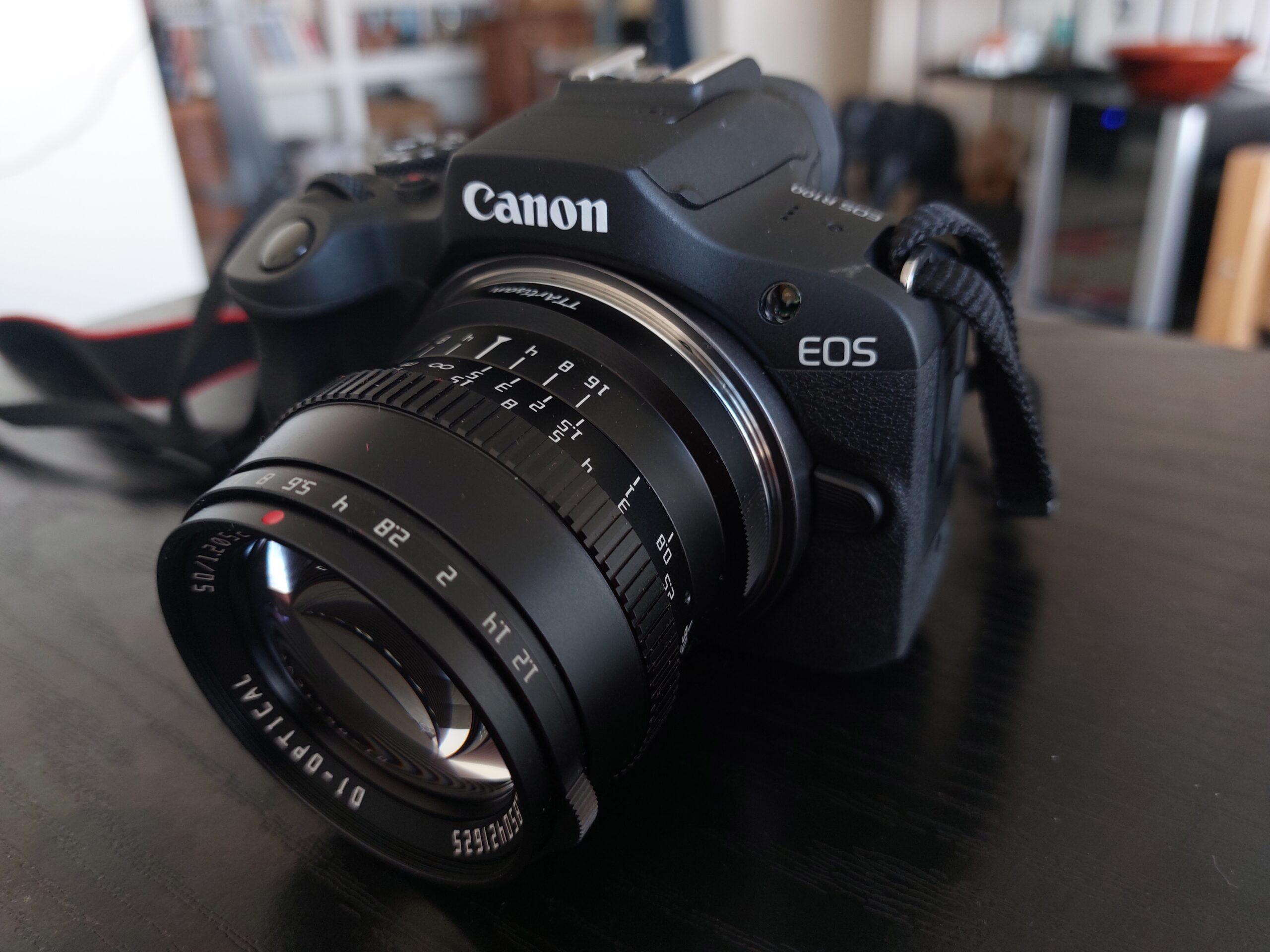
What 50mm f/1.2 means on Canon APS-C
Canon’s APS-C sensors have a 1.6x crop. A 50mm lens on an R100, R50, R10 or R7 frames like an 80mm lens on full frame. That’s head-and-shoulders portrait territory, close to the classic 85mm.
At f/1.2 the depth of field is thin. Very thin. At a normal portrait distance of a couple of meters, an eye can be sharp while the tip of the nose softens. Backgrounds turn to smooth color. Wide open, the TTArtisan is soft and glowy, with lower contrast and some purple fringing on bright edges. Stop down to f/2 or f/2.8 and it sharpens up a lot. That’s the trade with most cheap fast primes: character wide open, usable sharpness a stop or two down.
Close focus is 0.5 meters, so it isn’t a macro lens, but you can fill the frame with a face or a coffee cup.
Setting up a Canon body for a lens with no contacts
The first time you mount it, the R100 may refuse to take a picture. Canon cameras block the shutter when they can’t detect a lens. Go into the menu and switch on the setting that releases the shutter without a lens attached. After that it works normally.
Shoot in aperture priority. The camera meters through the lens whatever aperture you set on the ring, so exposure stays right even though the EXIF data will show no aperture or lens.
Focusing is the skill. Use the magnified live view on the rear screen or in the viewfinder, zoom in on the eye, and turn the ring until it snaps. If your body offers focus peaking, switch it on. For moving kids at f/1.2 you’ll miss a lot of frames. For a friend sitting still in window light, you’ll get pictures that look like they came from a lens costing ten times more.
Who should buy it, and what to buy instead
Buy it if you own an R100 or R50, you want to try portraits with real blur, and you’re curious about manual focus. At this price there’s very little to lose. It also suits video, where manual focus pulls are normal anyway.
Skip it if you shoot events, children or anything fast. Then the answer is Canon’s RF 50mm f/1.8 STM, which costs about $199 and focuses by itself, or the RF 85mm f/2 Macro IS STM if the budget stretches.
If you already know you’ll stay with Canon APS-C, our Canon EOS R100 review covers the body’s limits, and the Canon EOS R50 review explains why the R50 is the better long-term match for a lens like this. Shooters on Sony or Fujifilm APS-C who want an autofocus portrait prime should look at the Viltrox AF 75mm F1.2 Pro, which costs more and does the focusing for you.