Crop vs Full Frame for Travel Choosing the Camera and Lens Together
The lens is what catches my eye first. In this photograph, a traveler holds a camera with a substantial zoom pointing down toward the ground, its deep petal hood hovering beside her striped trousers. A black Nikon strap hangs in a loose curve across her white T-shirt, beneath the small blue words “Dressed for a fashion show.” Pale pink sun sleeves cover her arms and the backs of her hands. Above it all, a broad woven visor curls around her face, throwing shade over her eyes while her dark hair falls behind her shoulders. The pale stone balustrade recedes diagonally into the background, with warm paving below and dark green foliage beyond. There is lovely texture in the weave of the visor, and a quiet contrast between the soft clothing and the rather purposeful equipment. This is travel photography in its everyday physical form: sunshine, walking, something interesting just outside the frame, and a camera that has to come along for all of it.
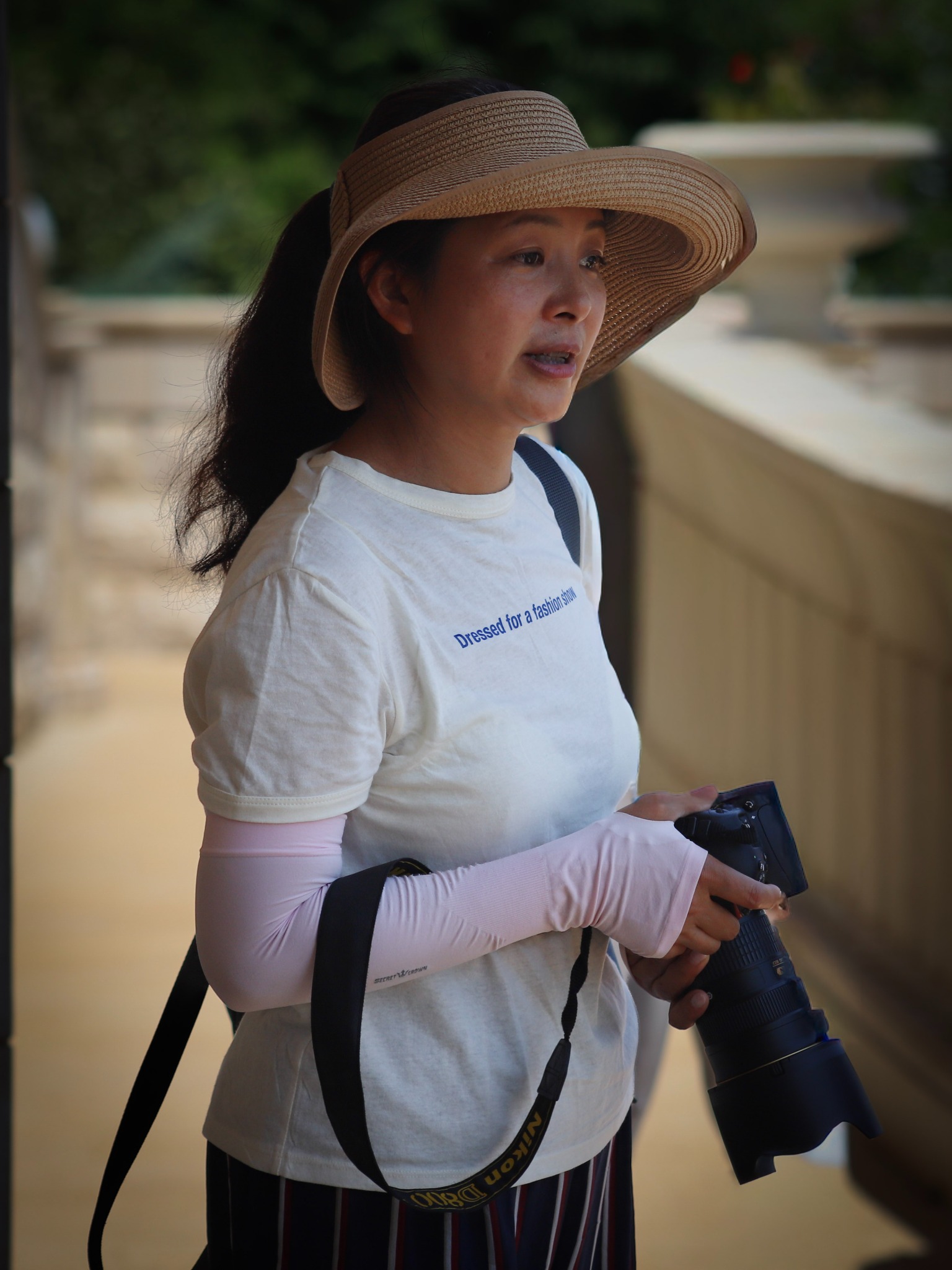
Photo credit: pxef.com.
The picture also makes a better starting point for the crop versus full frame discussion than another photograph of two bare camera bodies on a desk. We cannot reliably identify the exact body or lens from this view, and the photograph does not tell us the sensor format. What it does show is the complete thing someone carries. That is where I would begin choosing a travel combo. The body might save a little weight, but the lens, hood, strap and spare equipment still have to spend the afternoon with you. A compact body attached to an unnecessarily large zoom is a compact body attached to an unnecessarily large zoom. Your shoulder will be quite clear about the distinction.
APS-C and full frame change how you assemble that kit. With the same lens, APS-C records a narrower field of view. Canon APS-C uses a 1.6x factor: 50mm gives framing comparable to 80mm on full frame. The lens itself remains 50mm. Full frame generally offers an advantage at high ISO when comparing similar sensor generations and equal-sized output, and makes shallow depth of field easier at matched framing and the same f-number. Those are useful differences, but none tells you whether a particular camera and lens will suit your trip.
For a holiday built around long daytime walks, markets, gardens and occasional family pictures, I lean toward a small crop body with a modest zoom designed for that format. This is where APS-C earns its place in a travel bag. You can cover a useful range without automatically committing to a large lens. The qualification matters: put oversized glass on the small body and much of the carrying advantage disappears. Before buying anything, I would fit the intended lens, extend it to the longest setting, attach the hood and hold the combination for a while. Try operating the zoom with the camera raised. Try carrying it with one hand. A kit that feels awkward in a shop is unlikely to become charming halfway up a hill.
The wide end deserves more attention than it usually gets. Travel photography has a habit of putting your back against a wall, sometimes literally. A narrow street, a crowded restaurant table or a room with a decorated ceiling can leave very little space to step backward. On Canon APS-C, a 24mm lens frames roughly like 38mm on full frame, so a familiar full frame standard zoom can become surprisingly restrictive indoors. A dedicated crop wide-angle lens can solve that problem. Full frame does not have exclusive rights to architecture or landscapes; you simply need the right focal length for the sensor. I would check that before getting excited about how far the zoom reaches.
Then there are journeys where distant subjects are part of the point: birds along a shoreline, a performer across a square, details high on a building. A crop sensor can be useful here, particularly when its pixel density records more detail on the subject than cropping an available full frame image would retain. It is not free optical magnification, and the result still depends on resolution, focus, light and the lens. More practically, ask how often you actually make those pictures. Carrying a long zoom for one hypothetical bird can be a questionable bargain when most of your photographs happen within a few meters of where you stand. I have considerable sympathy for the desire to be prepared. It is also how bags become heavy.
Full frame becomes more attractive to me when the trip continues photographically after sunset. Evening streets, people in dim restaurants and moving subjects in available light can make its noise advantage useful. But the lens has a vote here too. Compare the actual combinations: a crop body with a bright prime and a full frame body with a slow zoom are making different compromises. Image stabilization can help keep a stationary building sharp at a slower shutter speed; it cannot stop a waiter, a child or a musician from moving. If those are your subjects, aperture, shutter speed and dependable focus deserve at least as much thought as the format printed in the brochure.
The softly rendered background in this photograph raises another temptation: choosing full frame for blur. The stonework and greenery fall away pleasantly, letting the face, visor and hands carry the picture. That appearance alone cannot establish the sensor size, aperture or focal length used. Subject distance and the distance to the background matter too. For travel portraits, separation can be lovely, but I do not always want the surroundings dissolved. Sometimes the café, harbor or tiled wall is why the portrait matters. A little more depth of field can preserve the story, and getting both people sharp in a quick photograph is often more valuable than producing the thinnest possible plane of focus.
My preferred way to settle the choice is to describe an ordinary day of the trip before describing the equipment. If the day means six hours outside, mostly in good light, with photographs made between other activities, a light APS-C combo is an excellent place to start. If the evenings matter as much as the mornings, and people in low light are central to the pictures, a compact full frame body with a sensibly sized lens becomes easier to justify. If a single small full frame prime covers what you enjoy photographing, that kit may be more agreeable than a crop body with a bulky zoom. Format is a starting constraint, not a reliable measurement of the finished bag.
I would also give the controls a proper trial. Can you change exposure compensation without looking away? Does the grip still feel secure with that lens? Can you reach the playback button, and does the viewfinder remain comfortable in bright sun? Bring the strap into the decision, along with a spare battery and the bag you will actually use. The photographer here has clearly thought about being outdoors: the broad visor, covered arms and camera held ready belong to the same practical arrangement. Camera shopping tends to isolate the hardware from the person. Travel reunites them fairly quickly.
There is no need to treat crop as an apprenticeship before full frame, or full frame as proof that a trip is being taken seriously. Choose the combination whose strengths fit the photographs you expect to make and whose inconveniences you are willing to live with. Then leave a little room for the unexpected. Looking at this image, I keep returning to the hands around the camera and the long lens hanging below them. Whatever its specifications, this is the equipment that made it out into the day. That is the first test a travel combo has to pass.