Best Camera for Instagram Influencers in 2026
An Instagram influencer buying a dedicated camera faces a different decision from a photographer building a traditional kit. The camera has to produce flattering portraits and sharp street photographs, then turn around and record a Reel with dependable face tracking, usable sound and a screen that faces the presenter. It has to fit into daily life, too. My best all-round choice for someone serious about both still pictures and video is the Sony A6700. That does not make it the right purchase for every influencer, especially someone who mostly films short pieces to camera.
The photograph makes a useful starting point. Two young people dressed largely in black walk along a worn stone-paved street. The woman has a layered dark-and-pink hairstyle, a fitted black dress with lace detailing, tights and tall lace-up boots. A Canon EOS Digital strap hangs around her neck, with camera equipment resting against her outfit. Her companion wears loose black trousers, white trainers and a dark top, with a backpack harness across his chest, a bag on his shoulder and a small silver device in his hand. The colorful shutter, old masonry, pavement texture and green foliage behind them give the picture character without stealing attention from the people. Their layered clothing and the camera strap are almost part of the street-style composition. Of course, we cannot tell what camera made this photograph, or whether either person is an influencer. The scene still captures something important about making social content: the equipment travels with the person, and the interesting moment happens while everyone is moving.
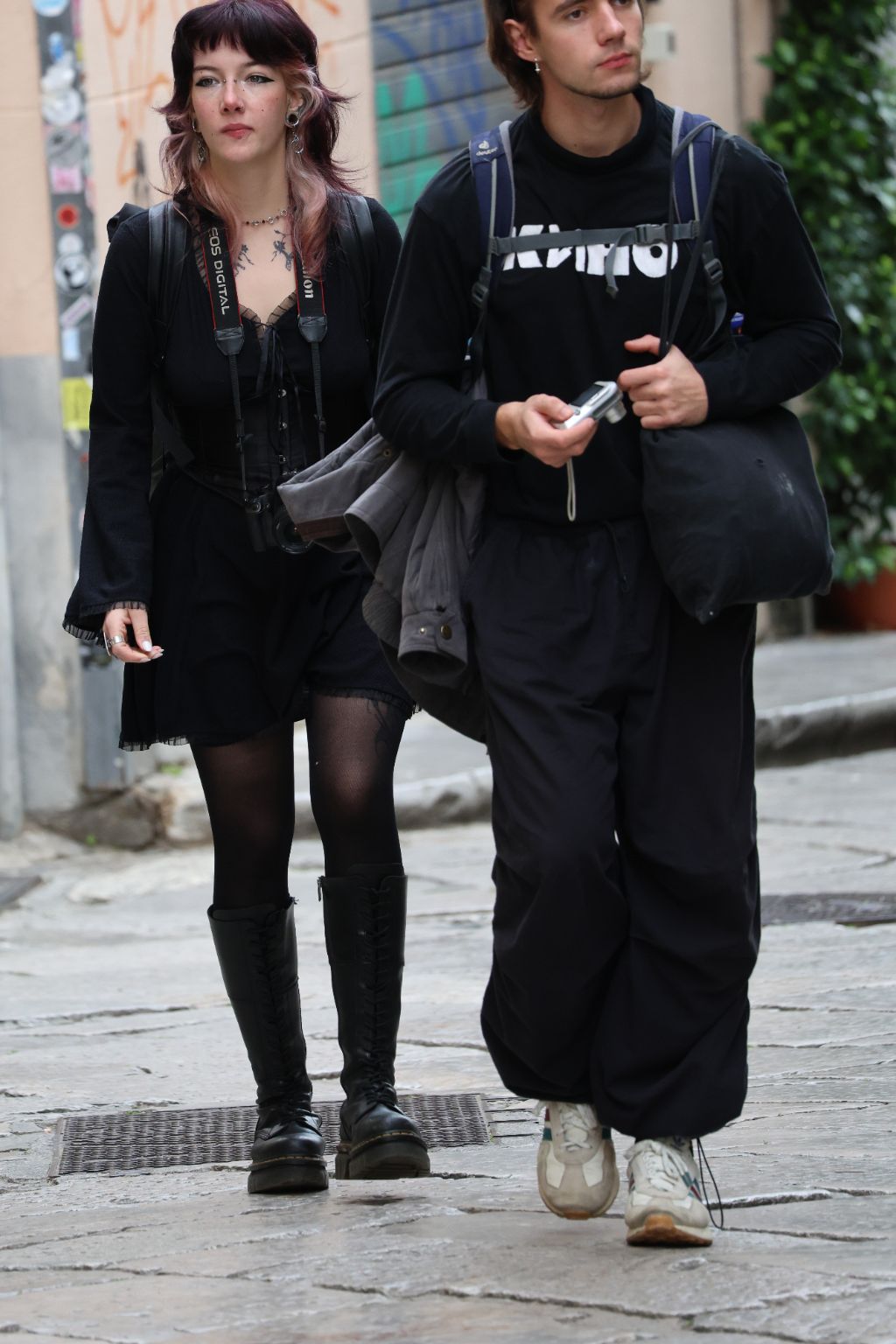
Photograph: MediaGallery.org
The A6700 earns its place because it handles that mixed workload well. Its 26-megapixel APS-C sensor provides plenty of detail for fashion portraits, restaurant photographs, travel posts and product work. Eye-detection autofocus helps when a subject is moving through the street rather than posing perfectly still. An eye-level viewfinder remains useful in hard sunlight, while the fully articulating screen serves self-recording. For video, it offers detailed 4K recording up to 60 frames per second, internal 10-bit options and five-axis in-body image stabilization. A small camera that can photograph a friend, film an outfit change and record a talking-head clip without swapping bodies has a real advantage. The limitation is cost. The body deserves a good lens, and the complete kit can become expensive quickly. Our Sony A6700 review covers the camera in more detail.
For a newcomer whose Instagram is primarily photographs with occasional Reels, the Canon EOS R50 is the more sensible starting point. It has a 24.2-megapixel APS-C sensor, effective subject tracking, a viewfinder and 4K video up to 30p oversampled from 6K capture. Put a modest portrait lens on it and a creator can make a noticeable change to the look of portraits compared with a typical phone’s wide main camera. The R50 does not have in-body image stabilization, however, and it lacks some advanced video tools. That matters less for carefully framed stills than for walking and talking. Our EOS R50 review is a good place to explore that trade-off.
If Reels, product demonstrations and face-to-camera videos dominate the schedule, two other bodies deserve attention. The Sony ZV-E10 II has a 26-megapixel APS-C sensor, strong autofocus, 4K up to 60p, 10-bit recording and access to Sony’s extensive E-mount lens selection. It sacrifices the viewfinder and in-body stabilization that make the A6700 more convenient for still photography and handheld shooting. The Canon EOS R50 V takes a similar video-first approach with dedicated recording controls, Canon Log 3 and 4K up to 60p, though 60p uses a substantial crop. That crop can turn a comfortable arm’s-length shot into an awkward close-up unless the lens is wide enough. Check the framing before buying. These are better choices for a creator who thinks in video sequences rather than photo sessions.
There is also a case for leaving interchangeable lenses at home. The DJI Osmo Pocket 4 is a very practical walk-and-talk tool thanks to its compact body, built-in three-axis gimbal and automatic subject tracking. It is less flexible for flattering telephoto portraits or carefully lit fashion photography because its lens is fixed. For someone making travel updates every hour, however, convenience can outweigh the appeal of a larger sensor and a bag of lenses. And a recent flagship smartphone remains the easiest way to shoot, edit and upload one short clip while walking to the next location. A dedicated camera is worth carrying when its control over perspective, lenses, motion or low light actually changes the result.
Whichever body you choose, spend time on the lens. For the Sony, a Sigma 18-50mm F2.8 DC DN is a compact, versatile option for portraits, interiors and street details. A wide lens such as the Sony E 11mm F1.8 makes arm’s-length recording easier, especially when video stabilization crops the frame. For the Canon R50, the compact RF-S kit zoom is useful for getting started, while the Canon RF 35mm F1.8 Macro IS STM offers a more deliberate portrait and detail-shooting perspective. Remember that APS-C crop factor changes how wide any lens feels. A lens ideal for portraits may be far too tight for a selfie.
Then come the less glamorous essentials. A small wireless microphone, a lightweight tripod, spare power and reliable phone transfer will improve an influencer’s daily work more than chasing another megapixel. Frame still photographs with enough room for a vertical 4:5 feed crop, and think separately about 9:16 Reels. Watch the background, keep eyes sharp and resist softening skin until it looks artificial. The photograph here succeeds partly because the people have personality and the street has texture. It would lose something if every irregularity were polished away.
My buying advice is straightforward. Choose the Sony A6700 for a serious Instagram account built around both photographs and video; choose the Canon EOS R50 to begin with an affordable photo-first kit; choose the Sony ZV-E10 II or Canon EOS R50 V when video is the main job. Do not buy a bigger camera simply to look like a creator. Buy one that is easy enough to keep with you when the next worthwhile moment arrives.
As an Amazon Associate I earn from qualifying purchases.