Travelling with a Full-Frame 15mm Fisheye Lens, Krakow Through a Different Perspective
Travelling with a 15mm fisheye lens on a full-frame camera changes how you see a city. Instead of isolating individual buildings, the lens draws the whole street into the picture. Architecture bends, the pavement expands, and people become part of an unusually immersive composition.
Krakow makes a particularly good subject. In this photograph, the brick tower of St. Mary’s Basilica anchors the distant view, while pastel façades rise along both sides of the street. The pedestrians and shopfronts make it a scene of ordinary urban life rather than a sterile architectural study.
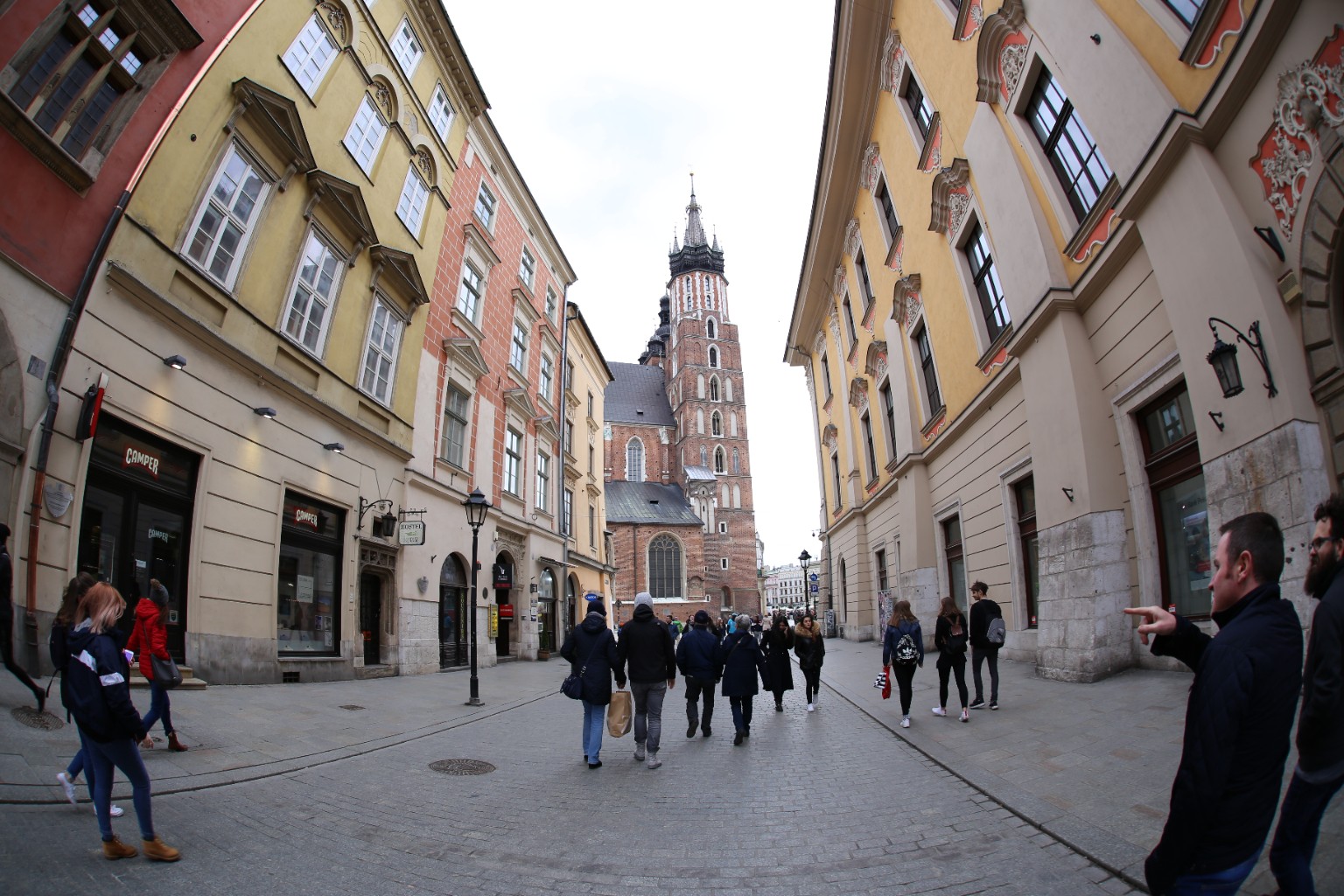
A fisheye is not simply a wider conventional lens. A diagonal 15mm fisheye on full frame can encompass roughly 180 degrees diagonally, depending on its design. Unlike rectilinear ultra-wide lenses, which work to preserve straight lines, a fisheye lets lines curve away from the center. In Krakow’s narrow historic streets, this distortion gives the buildings the feeling of leaning toward the viewer.
The trick is to make that distortion purposeful. Positioning the church near the center keeps it relatively recognizable, while the curved façades frame it almost like a theatrical set. Tilt the camera more and the geometry becomes more dramatic; keep the central axis level and the effect can be surprisingly restrained.
A short focal length also offers considerable depth of field. With a moderate aperture, nearby cobblestones, passing pedestrians and distant towers can all remain acceptably sharp. For spontaneous travel photography, that is a practical advantage: you can react quickly without constantly changing focus.
The challenges are real, though. Anything close to the edge can look stretched or oddly curved, especially faces. A fisheye includes so much of the scene that distracting objects can slip into the composition unnoticed. Watching the corners is as important as watching the subject. And if your objective is a geometrically faithful record of a building, a rectilinear lens will usually serve you better.
Software can straighten a fisheye photograph afterward, but that process stretches peripheral pixels and crops away some of the generous coverage. It is often better to embrace the optical character rather than try to erase it.
A 15mm fisheye would not be my only travel lens. It is too distinctive for every street scene, portrait or architectural detail. But that is also why it deserves space in a camera bag: it produces images that a normal wide-angle lens simply cannot. Historic streets, crowded markets, cathedral interiors and expansive squares become opportunities to explore space rather than merely document it.
This Krakow photograph succeeds because the distortion has a job to do. The buildings surround the viewer, the street draws the eye forward, and the people provide movement and scale. The result is less like looking at a postcard and more like standing in the middle of the city.