Canon R8 Travel Kit for a Week in Palermo With Three RF Lenses
I fly to Palermo today for a week. The bag is packed and it’s small. One body, three lenses, a few batteries. The whole kit weighs about 1.7 kg, which is less than a single 70-200mm f/2.8 on its own.
Here’s what’s going, and why each piece earned its spot.
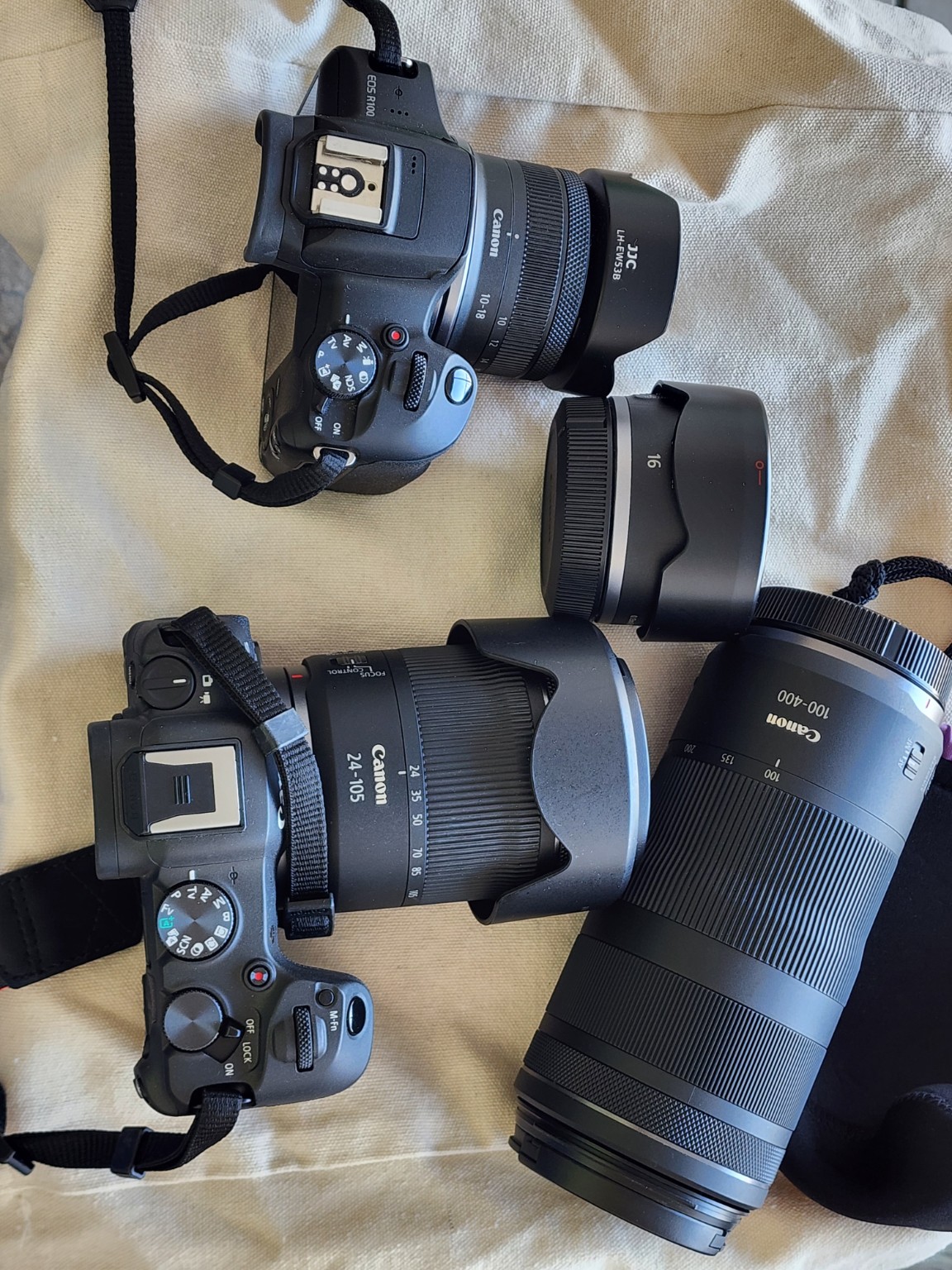
Image hosted by MediaGallery.org.
The photograph catches the packing dilemma in one frame. On the folds of cream-coloured fabric, the R100 sits at the upper left with the compact 10–18mm and its hood attached, while the R8 below it carries the 24–105mm, its strap crossing the camera and lens. The little 16mm rests between the two setups and the much longer 100–400mm, which runs diagonally down the right side beside a black pouch. Black straps curl around the edges, and the view from above makes the difference in size quite plain. Everything under consideration is here, including the small prime that might yet stay home.
The kit:
- Canon EOS R8, 461 g with battery and card
- Canon RF 16mm f/2.8 STM, 165 g
- Canon RF 24-105mm f/4-7.1 IS STM, 395 g
- Canon RF 100-400mm f/5.6-8 IS USM, 635 g
That’s 16mm to 400mm on a full-frame sensor. Nothing pro-grade in the glass. Nothing I’ll miss either.
The Body Is the Smallest Full Frame Canon Makes
The R8 carries the 24MP sensor from the R6 Mark II in a body that feels like a mid-range crop camera. For a week of walking it’s the right trade. You give up a few things, and one of them matters a lot on this trip: there’s no in-body stabilization.
So the lenses do the stabilizing. Both zooms have optical IS (5 stops on the 24-105, 5.5 on the 100-400). The 16mm has none at all. Inside Palermo’s churches that means picking shutter speeds carefully and letting ISO climb. The R8 handles ISO 6400 without drama, so I’m not worried.
Battery life is the real weak spot. The small LP-E17 runs dry fast, especially with the EVF. I’m packing three spares and charging every night. Non-negotiable on this body.
RF 16mm f/2.8 STM for Mosaics, Ceilings and Narrow Streets
Palermo is a city of interiors. The Cappella Palatina, the cathedral at Monreale, La Martorana. The Palermo must-see guide has the full list, and most of it is indoors under gold. Gold mosaics wrap the walls and the ceilings, and you can’t step back far enough with a normal zoom. At 16mm you get the whole apse in one frame.
The f/2.8 aperture buys about a stop and a half over the 24-105 at its wide end. In a dim chapel that’s the difference between ISO 3200 and ISO 10000. It also focuses down to 13 cm, which is handy for low-angle shots of tiled floors and fountain details.
Outside, it’s the lens for the old town’s alleys in Kalsa and Albergheria, where the buildings lean in and 24mm feels cramped. At 165 g and 40 mm long it lives in a jacket pocket.
RF 24-105mm f/4-7.1 Is the Lens That Stays On
Most frames of the week will come from this one. Street scenes at Quattro Canti. The food stalls at Ballarò and the Vucciria. Facades along Via Maqueda. Portraits of people who say yes.
It’s slow at the long end. f/7.1 at 105mm won’t win anything in a dark market hall. In daylight it doesn’t matter, and the IS keeps static subjects sharp at slow speeds.
The hidden trick is center focus macro. Set it to 24mm, switch to manual focus, and you get 0.5x magnification from 13 cm. Cannoli, arancini, a single mosaic tessera, the grain on a marble column. No macro lens needed.
RF 100-400mm f/5.6-8 for Compression and Distance
Packing a 400mm lens for a city break sounds odd. It isn’t. Palermo sits in a bowl between the sea and the mountains, and Monte Pellegrino towers over the north end of town. Long glass stacks the domes and bell towers against that mountain in a way no wide lens can.
It’s also my lens for rooftop details, the harbour, ferries and fishing boats, and candid street shots from across a piazza. At 635 g it’s light for the range. Nano USM focus is quick and quiet.
The catch is the f/8 at 400mm. In November the sun sets before five, so this lens works mornings and afternoons. Once the light fades it goes back in the bag.
One practical bonus: the 24-105 and the 100-400 both take 67mm filters. One circular polarizer covers both zooms. The polarizer earns its keep at Mondello beach, where it cuts the glare off the water and pushes the colour of the bay.
What I’m Not Bringing
No tripod. With stabilized zooms and a clean high-ISO sensor I don’t need one in town, and plenty of the sites don’t allow them anyway. No fast prime for low light either. The 16mm covers that job for interiors and the R8’s sensor covers the rest.
The Dilemma: A Canon R100 as Second Body
There’s one more box on the shelf, and I keep picking it up. A Canon EOS R100 with the RF-S 10-18mm f/4.5-6.3 IS STM on it. If it comes, the 16mm stays home.
The case for it is better than I expected.
Backup. One body on a week-long trip is one dropped camera away from shooting the rest of Palermo on a phone. The R100 is insurance that also takes pictures.
Same batteries. Both bodies run on the LP-E17. No second charger, no second set of spares. The three batteries I’m already packing just get shared.
No lens swaps. The 10-18mm lives on the R100, the 24-105 lives on the R8. Wide and normal, both ready, no changing glass in a dusty market or in the salt wind at Mondello. Only the 100-400 still needs a swap.
Reach. The R100 has an APS-C sensor, so the 100-400 frames like a 160-640mm there. Both bodies are 24MP, so that’s real extra reach, not a crop of the R8 file. Handy for Monte Pellegrino and the harbour.
Stabilization where it counts. The 10-18mm has 4 stops of optical IS. The 16mm has none, and the R8 has none in the body either. For static subjects like mosaics and ceilings, that’s a fair trade.
And the case against.
Light. The 10-18mm is f/4.5 at the wide end against f/2.8 on the 16mm, and it sits on a smaller sensor. In a dim chapel the IS helps with the walls. It doesn’t help with people walking through the frame.
Weight. The R100 is 356 g with battery and card, the 10-18mm about 150 g. Swap out the 165 g prime and the bag gains roughly 340 g. Call it 2 kg for the whole kit.
Handling. The R100 has a fixed screen, so low-angle shots over tiled floors are harder. It’s a basic body with fewer dials. And two cameras on two straps look a lot more like a tourist with gear worth taking.
The 10-18mm also goes a little wider and covers more, about 16-29mm in full-frame terms against the fixed 16mm. One lens does the prime’s job and a bit of the 24-105’s.
So, undecided. The R100 makes the trip safer and faster to shoot. The R8 alone makes it lighter. The bag’s by the door.
The Bag
- R8 with the 24-105 mounted
- 16mm in a pocket, or the R100 with the 10-18mm in its place
- 100-400 in the bag, hood reversed
- Three spare LP-E17 batteries
- Two SD cards, swapped every evening and backed up
- 67mm circular polarizer
- Lens cloth and a small blower for the dust and sea air
That’s it. Small enough to carry from breakfast to dinner without thinking about it, and I’ll report back with photos from whatever makes the cut.