Sony Event Photography Combos: Two Bodies, a 24-70mm and the FE 70-200mm F2.8 GM II
Event photography has three problems that never go away. The light is bad. You can’t move freely, because there are chairs, guests and a speaker you mustn’t block. And the moment you need happens once. Conferences, weddings, launches and awards nights all share them.
The kit that solves them hasn’t changed much in twenty years, and on Sony it’s easy to build. Two bodies, a standard zoom on one and a 70-200mm on the other. You never change lenses during the important part.
The photo shows the long half of that kit at work: a Sony body with the white 70-200mm, used from the back of a seated audience. From there, 200mm frames a speaker from the waist up without anyone noticing you.
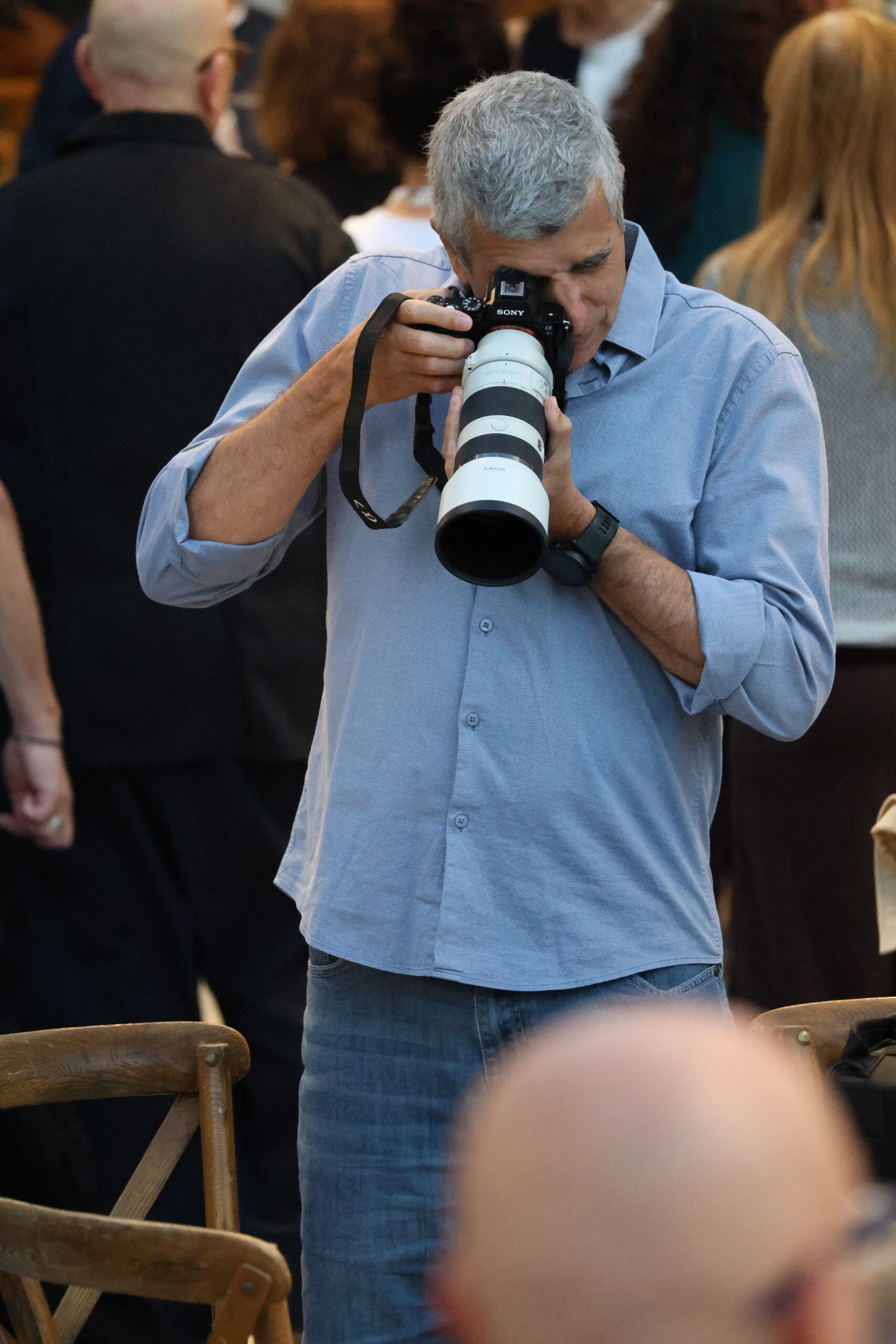
The long lens: FE 70-200mm F2.8 GM OSS II
The Sony FE 70-200mm F2.8 GM OSS II is the event lens on Sony. About 1,045 grams, f/2.8, stabilized, and fast enough to track a speaker walking the stage. At f/2.8 it separates the person at the podium from the projector screen behind them.
The budget alternative is Tamron’s 70-180mm F2.8 G2, at about 855 grams and less than half the price. It now has stabilization too. You lose 20mm at the long end, which matters only from the very back of big rooms.
The short lens: 24-70mm or something faster
The FE 24-70mm F2.8 GM II covers the room, the group shots and the handshakes. At 695 grams it balances well on any Sony body. The Tamron 28-75mm G2 or Sigma 24-70mm DG DN II do the same job for much less.
Dark rooms push some shooters to f/2. Sony’s FE 28-70mm F2 GM, launched in late 2024 at $2,899.99, keeps f/2 across the whole zoom range at 918 grams. It’s heavy and expensive, and it gains you one stop. That’s the difference between ISO 6400 and ISO 3200 in a hotel ballroom, which on most bodies is a real gain in skin detail.
For the most light, add one prime. The FE 50mm F1.4 GM or FE 85mm F1.4 GM II is two full stops faster than the zooms for candid moments at the after-party.
The bodies
The Sony A7 V is the event body most people should buy now. Its faster sensor readout cuts the rolling-shutter distortion that used to make the silent electronic shutter risky under stage LEDs and with moving subjects. Silent shooting matters at speeches and ceremonies.
The A7 IV remains a great second body. Pair an A7 V and an A7 IV, put the 70-200mm on the newer one for its faster autofocus, and you have a full kit at a sensible price.
At the top, the A9 III with its global shutter avoids rolling-shutter distortion entirely, along with the stripes that flickering LED lighting can leave across a rolling-shutter frame. The A1 II adds 50MP for crops.
One-lens alternative
Some event shooters skip the two-body routine and use the Tamron 35-150mm F2-2.8. It covers both halves of the kit at f/2 to f/2.8, weighs about 1,165 grams, and lets you work with one camera. You lose the wide end below 35mm, so a small prime in a pocket is still a good idea.
The kit to start with
An A7 V with the 70-200mm GM II, an A7 IV with the Tamron 28-75mm G2, and an 85mm prime in the bag. It covers conferences, weddings and stage events, and leaves room in the budget for spare batteries, which you’ll need.