Adapting Canon EF L Telephoto Lenses to RF Mirrorless: Used Super-Telephotos at a Fraction of the New Price
For decades, Canon’s white EF L telephotos were the lenses you saw lined up at every stadium and every bird reserve. Canon has since moved to its mirrorless RF mount, and many of those EF lenses are now on the used market. They don’t stop working. On a modern RF camera with Canon’s adapter, most of them focus as well as they ever did, often better.
That makes adapted EF glass one of the best-value routes to serious telephoto reach on Canon mirrorless.
The store cabinet below is from the EF years: a row of white L zooms and primes, with a big 400mm f/2.8 standing in the middle. Every one of them can still go to work on an RF body.
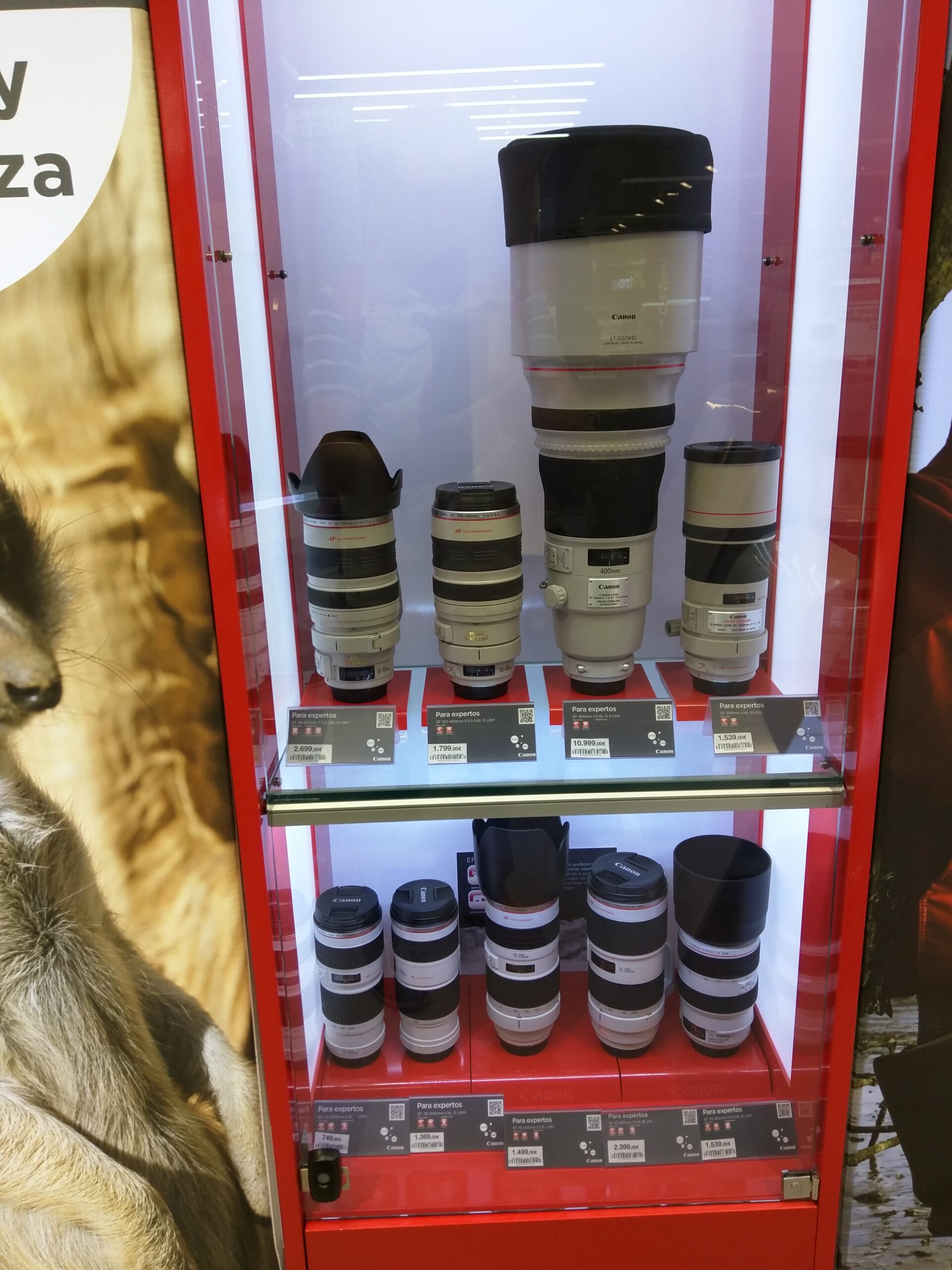
Photo: Media Gallery
How adapting works
Canon’s EF-EOS R adapter is a simple spacer with electronic contacts and no glass. EF lenses keep full autofocus, image stabilization and aperture control, and their image quality doesn’t change. Canon sells three versions: a basic one, one with a control ring, and one with drop-in filters, which is handy for video with long lenses that can’t take front filters.
On mirrorless bodies with Dual Pixel autofocus and subject detection, many EF telephotos actually track birds and athletes better than they did on the cameras they were designed for. Older lenses with slow motors won’t suddenly become fast, but Canon’s ring-USM L lenses generally work very well.
Which EF telephotos are worth adapting
EF 100-400mm f/4.5-5.6L IS II USM. One of the best-loved wildlife zooms Canon made, sharp and fast-focusing. A strong alternative to the RF 100-400mm F5.6-8 if you want a brighter aperture and pro build.
EF 70-200mm f/2.8L IS II and III USM. The event workhorses. Used copies cost far less than the RF 70-200mm F2.8 Z, though they’re bigger and lack its internal zoom and power-zoom option.
EF 300mm f/2.8, 400mm f/2.8 and 500mm f/4 IS primes. The big whites. The newer IS II versions are lighter and sharper than the originals. On the used market they can cost a fraction of a new RF super-telephoto. They’re heavy, and they reward patient wildlife and sports shooters.
Extenders and quirks
EF lenses take EF extenders, which mount between the lens and the adapter. Canon’s RF extenders don’t fit EF lenses.
Check that a lens is supported by Canon for use on RF bodies. Most L lenses are; a few very old ones and some third-party EF lenses have quirks. Older IS units are noisier than modern ones, which matters for video.
On APS-C bodies like the EOS R7, the 1.6x crop turns a 400mm lens into a 640mm field of view. An adapted EF 100-400mm II on an R7 is one of the most capable bird kits you can build for the money.
Buy carefully
Super-telephotos lead hard lives. Check the front element, the focus and IS motors, and the mount for wear, following our used gear checklist. A well-kept EF L telephoto on a modern RF body is a combination that will keep working for many years.